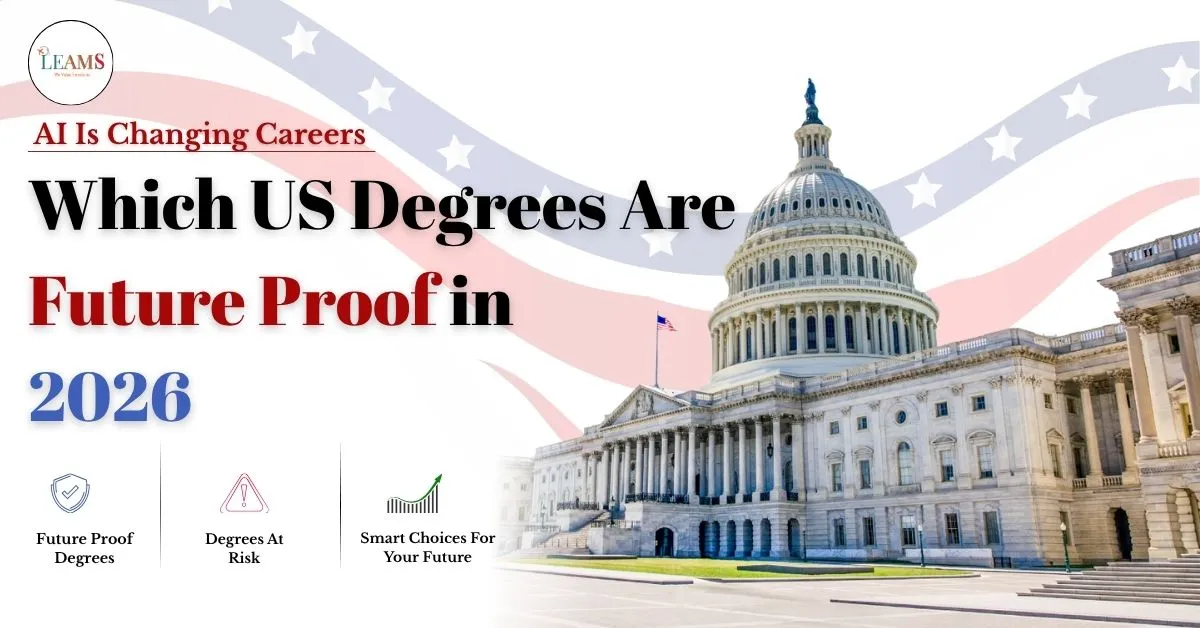

The AI Effect: Which US Degrees Are Future-Proof in 2026 And Which Are Not
"Is Your US Degree Safe from AI? Here's What No One Is Telling Indian Students"
Imagine spending ₹40–60 lakhs on a US Master's degree - only to graduate into a job market where AI already does what you studied for four years to learn. This is not a fear. This is happening right now.
A student at Miami University switched her major from Business Analytics to Marketing after realizing her core skills - coding and statistical analysis - were being automated by AI tools. She is not alone. Thousands of students across America are asking the same scary question:
"Will my degree still matter by the time I graduate?"
For Indian students and working professionals planning to study in the USA, this question is more important than ever. Because choosing the wrong degree today could mean the wrong career tomorrow.
In this blog, we break down exactly which US degrees are future-proof in 2026 and which ones AI is already replacing.
How Big Is the AI Threat Really?
Artificial Intelligence (AI) is rapidly transforming the US job market, and Indian students planning to study in the USA must understand its impact before choosing a course.
Recent reports show that AI is replacing nearly 16,000 jobs every month in the United States, with entry-level roles being affected the most. Young professionals and fresh graduates are facing increased competition as companies adopt AI-driven technologies.
A growing number of students are already responding to this change. Studies reveal that nearly 1 in 6 US college students has changed their major due to concerns about AI's impact on future careers.
Degrees That Are at RISK in 2026
While these degrees still offer valuable career opportunities, students should carefully evaluate future job market trends and focus on developing advanced, AI-related skills.
Computer Engineering
Traditional coding and routine software development tasks are increasingly being automated. Students should complement their studies with expertise in AI, cybersecurity, cloud computing, and emerging technologies.
Electrical and Mechanical Engineering
While fundamental engineering positions will always hold value, there might be a need for automation, robotics, Industry 4.0, and AI knowledge among others.
Basic Data Analytics and Entry-Level Coding
Most data processing and reporting activities that involve repetition have been automated through AI. There is a rising need for experts capable of making data-informed decisions.
Degrees That Are SAFE in 2026
While no profession is completely immune to technological change, the following degrees are expected to remain relatively resilient in the AI-driven economy.
Medicine & Healthcare
Healthcare continues to offer some of the strongest long-term career prospects. AI can support doctors by improving diagnostics, data analysis, and patient management, but it cannot replace the clinical judgment, empathy, and hands-on care provided by medical professionals.
Law
Although AI is automating routine legal research and documentation, lawyers are still needed for complex negotiations, litigation, strategy, and client representation.
MBA and Business Leadership
An MBA continues to deliver strong career outcomes, particularly for professionals who combine business knowledge with AI, analytics, and digital transformation skills.
Psychology and Human Sciences
Careers focused on human behaviour, counselling, mental health, and social interaction are among the least vulnerable to automation.
The New Career Winner in 2026: AI + Any Degree
In today's rapidly evolving job market, having a degree alone is no longer enough. Employers increasingly value graduates who can effectively use Artificial Intelligence (AI) alongside their professional expertise.
Research shows that professionals with AI skills often earn significantly higher salaries than those relying solely on traditional qualifications. In fact, careers that combine AI with disciplines such as economics, business, healthcare, and engineering are expected to experience strong growth in the coming years.
The most successful graduates of the future will not necessarily come from "AI-proof" fields. Instead, they will be those who combine domain expertise with AI literacy.
Whether studying medicine, business, law, engineering, or the arts, students who understand how to leverage AI tools will have a competitive advantage in the global job market.
What Should International Students Do in 2026?
Universities worldwide are already adapting to the AI revolution by integrating AI competency into their academic programs. This highlights the growing importance of AI literacy for future graduates.
1. Choose Degrees That Emphasize Human Skills
- Healthcare and Medicine
- Law
- Education
- Psychology
- Creative and Design Fields
2. Develop AI Skills Alongside Your Degree
Students should learn how to use AI tools relevant to their industry through:
- AI certifications
- Data analytics courses
- Automation tools
- Prompt engineering and generative AI platforms
3. Prioritize Internships and Work Experience
Practical experience remains one of the strongest predictors of employment success. Internships help students build industry connections, develop real-world skills, and improve graduate employability.
4. Select Universities with AI-Integrated Curriculam
When choosing a university, students should look for institutions that actively incorporate AI, digital technologies, and industry-focused learning into their programs.
Final Thoughts
AI is not replacing every job but it is transforming almost every profession. Students planning to study abroad in 2026 should focus on developing both academic expertise and AI competency to remain competitive in the future workforce.
Confused about choosing the right course in the age of AI?
Get expert guidance from our specialists and discover future-ready degrees, universities, and career pathways that align with the evolving global job market.
Book your free counselling session today.
Contact us on the below details:
WhatsApp: +91 77383 52427
Email: ladhani@leamss.com
Website: leamss.com
FAQs on AI Effect on US Degrees in 2026
Q1. How is AI affecting the US job market in 2026?
AI is transforming the US job market by automating many routine and entry-level tasks, particularly in fields such as IT, marketing, administration, and finance. As a result, employers increasingly seek candidates with AI skills and practical experience.
Q2. Will AI replace jobs in the USA in 2026?
Maybe, AI is replacing some repetitive and entry-level jobs, but it is also creating new career opportunities in emerging fields. Professionals who can work alongside AI are expected to have stronger employment prospects.
Q3. What AI skills should students learn in 2026?
Students should learn generative AI tools, data analytics, prompt engineering, automation platforms, and AI-assisted problem-solving. These skills can significantly improve employability in the global job market.
Q4. Can AI replace doctors, lawyers, and teachers?
No, AI can assist doctors, lawyers, and teachers by improving efficiency and handling routine tasks, but it cannot fully replace human expertise, empathy, judgment, and interpersonal interaction required in these professions.
Q5. Can AI skills increase salary opportunities?
Yes. Employers increasingly pay a premium for professionals with AI skills because they can improve productivity, automate workflows, and drive innovation within organizations.
 Back to Home