
Emerging Study Abroad Destinations 2026 – Beyond USA, UK & Canada
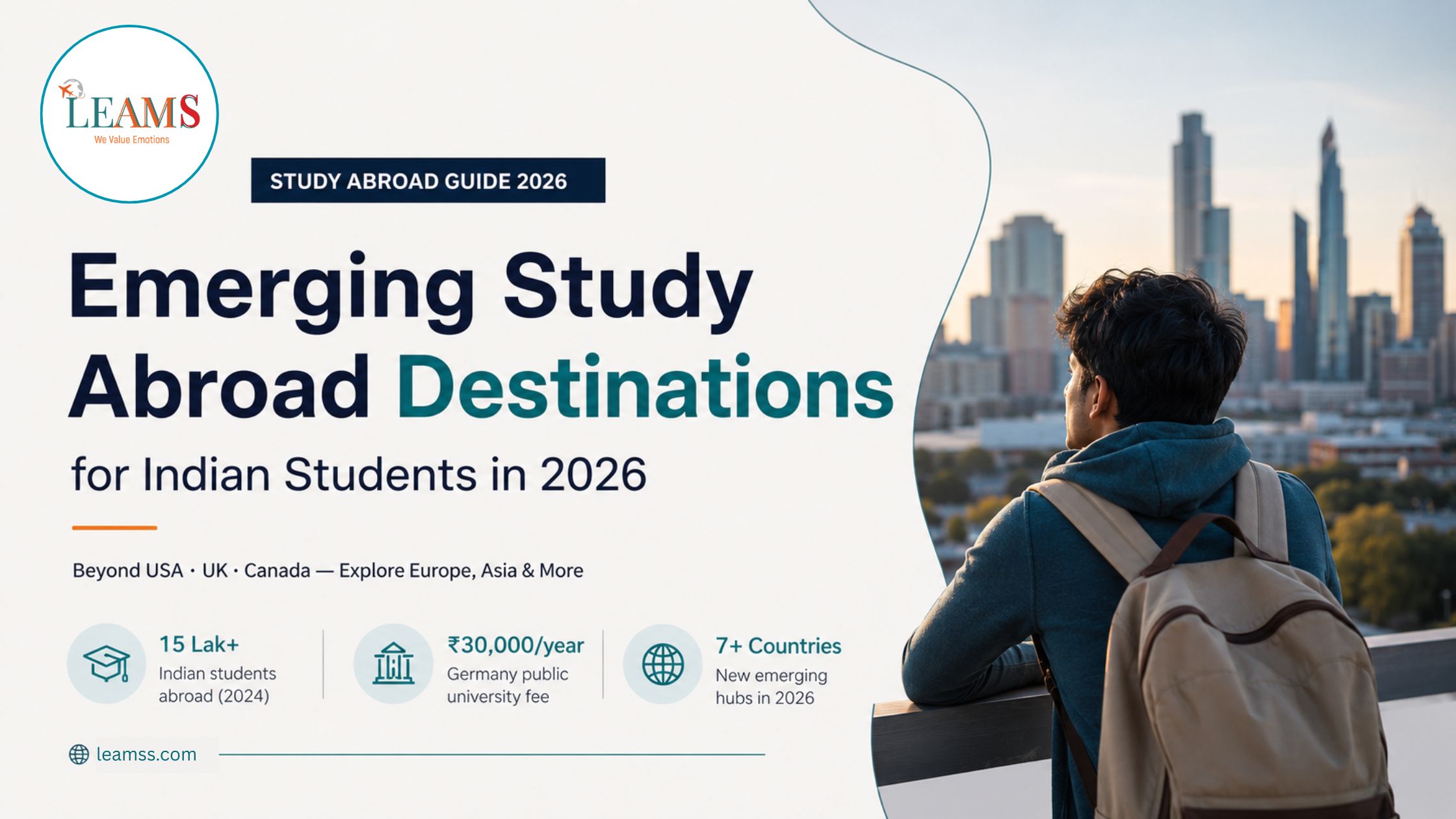
Emerging Study Abroad Destinations for Indian Students in 2026: Beyond USA, UK & Canada
The dream of studying abroad is no longer confined to the USA, UK, or Canada. In 2026, over 13 lakh Indian students are expected to pursue higher education abroad — and a significant number are now choosing emerging, affordable destinations over traditional ones. With UK student visa rejections rising, Canada imposing strict intake caps, and US universities tightening admission norms, Indian students are discovering powerful alternatives — from MBBS in Kyrgyzstan and engineering in Poland to luxury brand management in Italy and game design in Finland.
This 2026 guide covers the best emerging study abroad destinations for Indian students, the most in-demand courses, real cost comparisons, and how these pathways lead to global migration opportunities.
| Synopsis | Faced with rising costs and intense competition in India, students are increasingly seeking higher education in unconventional destinations like Kyrgyzstan, Cambodia, and Malta. These locations offer affordable options for courses like MBBS, engineering, and supply chain management. Many view these institutions as stepping stones to opportunities in Western Europe, the Middle East, and other developed regions. |
The Traditional Routes for Migrating Abroad
For decades, Indian students have flocked to the USA, UK, Canada, Australia, and New Zealand. These destinations offered quality education, job opportunities, and long-term migration pathways. However, numbers are shifting as policies tighten.
How Traditional Destinations Are Shifting (2023 vs 2026)
| Country | 2023 Indian Students | 2026 Trend | Key Reason for Change |
| USA | 2,68,923 | Stable | Strong but expensive |
| Canada | 3,19,000 | ⬇ Declining | Intake caps imposed |
| UK | 1,43,000 | ⬇ Declining | Visa tightening |
| Australia | 1,22,000 | ⬇ Slight dip | Cost + visa rules |
| Germany | 42,000 | ⬆ Rising | Free public universities |
| Poland | 18,000 | ⬆ Rising | Affordable EU education |
| Kyrgyzstan | 15,000+ | ⬆ Rising | MBBS affordability |
Popular Courses: Offbeat Choices
Indian students are breaking stereotypes and choosing niche programs that offer affordability, practical exposure, and global recognition.
MBBS – Kyrgyzstan, Bangladesh, Mauritius
Engineering – Poland, Malaysia
Supply Chain Management – Malta, Austria, Scandinavia
Renewable Energy – Scandinavian countries
Design – Italy, Greece, Netherlands, Vietnam, Georgia
Culinary Arts – Japan, Bulgaria, Türkiye
Hospitality – Cyprus, Malta, Spain, Malaysia, UAE
Cultural Studies – Austria, Egypt, Hungary, Nepal
Luxury Brand Management – Italy, Spain, Switzerland, UAE
Top Emerging Study Destinations for Indian Students in 2026 — Country-wise
🇵🇱 Poland
Best for: Engineering, Medicine, IT
Average tuition: ₹9.5–17.5 lakh/year
Why in 2026: EU member, post-study work visa available, growing Indian student community
🇩🇪 Germany
Best for: Engineering, Business, Sciences
Average tuition: ~₹30,000/year (public universities — almost free)
Why in 2026: No tuition fees at public universities, strong job market, PR pathway available after 2 years
🇰🇬 Kyrgyzstan
Best for: MBBS
Average tuition: ₹15–25 lakh for full degree
Why in 2026: 6,000+ Indian students already enrolled,
WHO-recognized universities, MCI/NMC screening eligible
🇲🇹 Malta
Best for: Supply Chain Management, Hospitality, Business
Average tuition: ₹8–14 lakh/year
Why in 2026: EU country, English-medium programs, stepping stone to Western Europe
🇫🇮 Finland
Best for: Game Design, Education, Technology
Average tuition: ₹0–12 lakh/year (some programs free)
Why in 2026: World's best education system, innovation-focused curriculum
🇮🇹 Italy
Best for: Design, Fashion, Luxury Brand Management, Culinary Arts
Average tuition: ₹3–15 lakh/year
Why in 2026: World-class design schools, strong industry connections, post-study work options
🇬🇪 Georgia
Best for: MBBS, Business
Average tuition: ₹12–20 lakh for full MBBS degree
Why in 2026: Fast-growing destination, EU-aligned curriculum, affordable living costs
Not Out of Syllabus: Trending Courses
Lighting and Light Design
Architectural, stage, and urban lighting programs blending technology with creativity.
Hubs: Milan (Italy), Bilbao (Spain), Stockholm (Sweden)
Music Therapy
A rising course using music for emotional and physical healing.
Hubs: Limerick (Ireland), Netherlands
Cruise Line Management
Specialised hospitality and operations training for the booming cruise industry.
Hubs: Spain, Switzerland
Molecular Gastronomy
Fusing science and cooking to redefine dining experiences.
Hubs: Spain, Japan, Netherlands
Game Designing
With gaming booming, students are mastering development and production.
Hub: Finland
Green Supply Chain
Building eco-friendly and low-carbon logistics systems.
Hubs: Scandinavia (Sweden, Denmark), Netherlands
Humanitarian Logistics
Managing aid and disaster relief supply chains.
Hubs: Finland, Belgium, Switzerland, South Africa
Demand Outstrips Supply
Over 22 lakh NEET aspirants competed for just 1.1 lakh MBBS seats in India in 2025. This severe shortage is a major push factor. Countries like Uzbekistan already host over 6,000 Indian MBBS students due to affordability and better access.
The Cost Factor
Affordability plays a huge role in decision-making.
India (Private MBBS): ₹1 crore+ for a degree
Uzbekistan / Russia / Philippines: ₹15–35 lakh
Poland / Czech Republic: ₹9.5–17.5 lakh per year (tuition + living)
Germany (Public Universities): ~₹30,000 per year
With 83% of education agents citing affordability as the top factor, cost-conscious decisions dominate the 2026 study abroad landscape.
Hidden Costs Indian Students Forget in 2026:
Living expenses vary widely — Germany and Poland cost ₹50,000–80,000/month, while Kyrgyzstan and Bangladesh average ₹25,000–40,000/month. Health insurance, visa fees, and travel costs add ₹1–3 lakh per year to your total budget. Always calculate total cost of attendance (CoA), not just tuition fees.
Small-Town Dreams
Unlike a decade ago, students from tier-2 and tier-3 cities like Vijayawada, Warangal, and Tirupati are now driving the outbound student wave, making foreign education more inclusive.
Education = Migration
For many, education abroad is not the final stop but a stepping stone toward global migration.
Europe’s Small Hubs → Western Europe: Students in Malta, Poland, and Cyprus often move to France, Germany, or the Middle East after graduation.
MBBS in Asia → Middle East Jobs: Students in Bangladesh, Kyrgyzstan, and Uzbekistan migrate to Gulf nations for better pay.
Engineering in Eastern Europe → Western Europe Careers: Students from Romania and Hungary often shift to Germany or the Netherlands.
IT & Business in Southeast Asia → Singapore, UAE, Australia: Students from Vietnam and the Philippines leverage affordable education to enter global markets.
Emerging On The Radar
The rise of Kyrgyzstan, Bangladesh, Georgia, and Malta highlights a structural reset in student migration. These countries, once overlooked, are now shaping the future of global higher education for Indians.
How to Choose the Right Study Abroad Destination in 2026 — LEAMSS Checklist
Before finalising your destination, answer these 5 questions:
1. Is the degree recognised in your target career country?
Check: WHO list (MBBS), NARIC (Europe), WES (North America)
2. What is the post-study work visa policy?
Germany, Poland, and Malta offer strong post-study work options. Kyrgyzstan and Bangladesh do not.
3. What is the total cost including living expenses?
Always calculate tuition + accommodation + food + health insurance + travel.
4. Is there a migration pathway after graduation?
Many students use Malta → Germany, Poland → Netherlands, or MBBS Asia → Gulf as stepping-stone routes.
5. Is the university accredited and recognised in India?
For MBBS: NMC/WHO approval is mandatory to practise medicine in India or the Gulf.
Final Thoughts
The era of education abroad being synonymous with the USA or the UK is changing. Indian students are embracing new hubs, offbeat courses, and affordable pathways that also act as springboards to global opportunities. This evolution marks not just a trend, but a long-term transformation in how India’s youth views higher education and migration.
 Back to Home