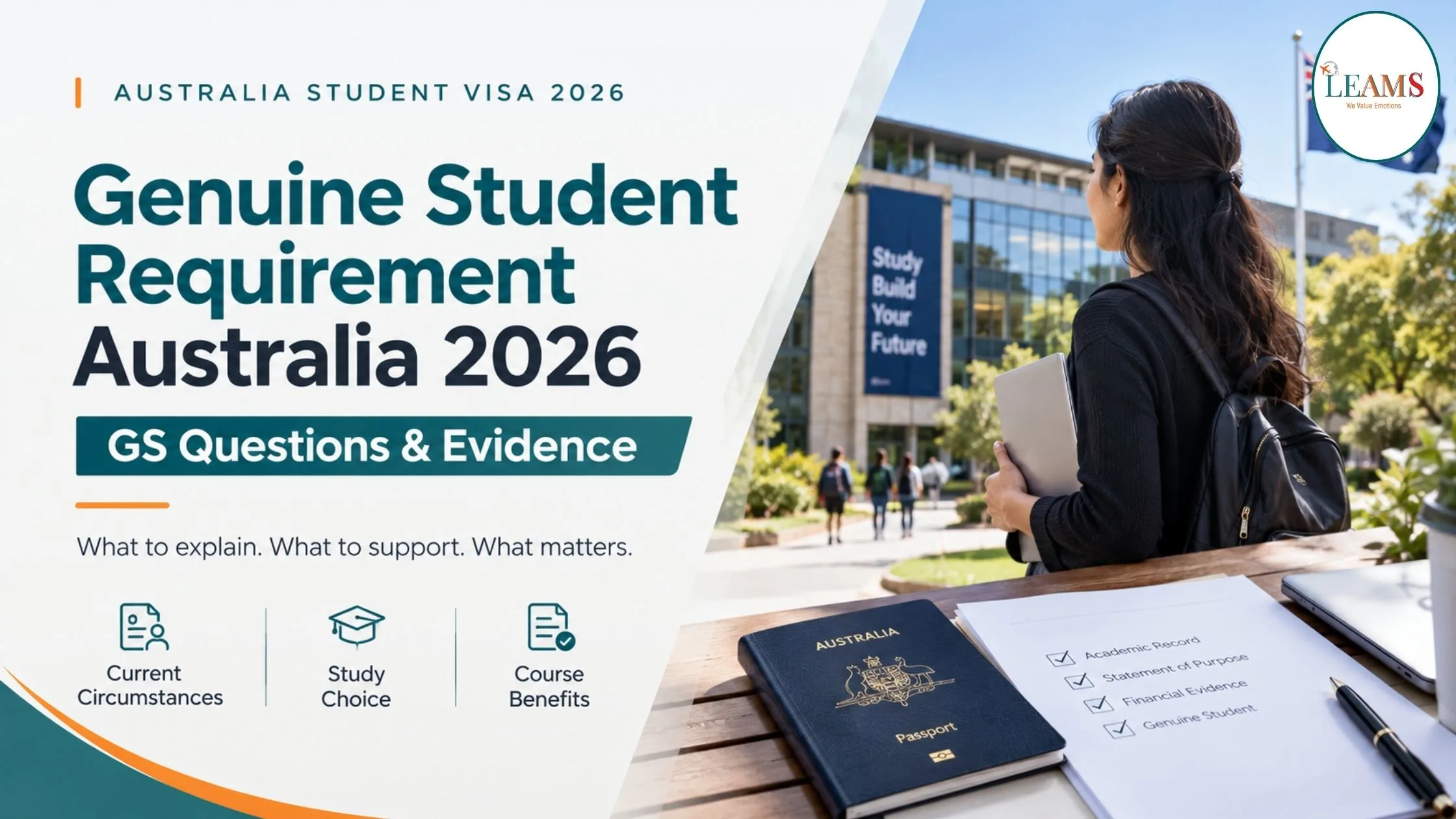
If you are applying for an Australian Student visa in 2026, the Genuine Student (GS) requirement is one part of your application you should not treat as a formality.
The GS requirement helps the Department of Home Affairs understand why you want to study in Australia, why you chose your course and provider, and how the course fits your future plans.
Here is what you need to know before submitting your Student visa application.
What is the Genuine Student requirement?
The Genuine Student requirement applies to Australian Student visa applications lodged on or after 23 March 2024. It replaced the previous Genuine Temporary Entrant (GTE) requirement for new applications.
Under GS, you need to show that:
you are a genuine applicant for entry and stay as a student; and
studying in Australia is your primary reason for applying for the Student visa.
Importantly, the GS requirement does not mean you have to say that you will never consider permanent residence. Home Affairs recognises that genuine students may later become eligible for other Australian visa pathways.
What matters is that study is your main purpose when applying for the Student visa.
What are the GS questions?
The questions are answered directly in your online Student visa application.
1. What are your current circumstances?
Explain your current education, employment, family or community ties and economic circumstances.
Think about: Where are you working or studying now? What is your background? How does studying in Australia fit into your current situation?
2. Why this course, Australia and this provider?
Explain why you selected the particular course and education provider.
You should also demonstrate that you understand the course and have researched studying and living in Australia.
Avoid generic statements such as “Australia has good education.” Explain what specifically makes your chosen course relevant to you.
3. How will the course benefit you?
Connect the proposed course with your previous education, employment or future career plans.
For example, explain what skills or qualification you expect to gain and how they can improve your employment prospects.
4. Is there anything else relevant?
Use this section for information that may help explain your circumstances, such as a significant study gap, course change or other relevant background.
Some applicants also receive an additional GS question if they have previously held a Student visa or are applying in Australia from a non-student visa.
How many words can you write?
Each GS response has a maximum limit of 150 words and must be written in English.
- That means you do not need a long essay.
- A good answer should be:
Specific + honest + relevant + supported by evidence.
Home Affairs prefers applicants to answer the GS questions in the online application rather than simply attaching a separate GS statement.
What evidence should you provide?
Your answers should match the documents in your application.
Depending on your circumstances, relevant evidence can include:
- academic transcripts and certificates
- previous Australian study records
- current or recent employment evidence
- payslips or employment contracts
- CV or résumé
- evidence of family and personal ties
- business or employment records
- income tax returns
- bank statements
- relevant future employment information
Home Affairs states that more weight is given to statements supported by evidence.
So, don't write something in your GS response that you cannot reasonably support with your documents.
How does Home Affairs assess your GS application?
The Department looks at your overall circumstances rather than one sentence in isolation.
It may consider:
- your circumstances in your home country
- your potential circumstances in Australia
- the value of the course to your future
- your previous study and qualifications
- your immigration and travel history
- your compliance with previous visa conditions
- any other relevant information
The assessment framework is set out under Ministerial Direction No. 106.
GTE vs GS: what's the difference?
The Genuine Temporary Entrant (GTE) requirement applied to Student visa applications lodged before 23 March 2024.
The Genuine Student (GS) requirement applies to applications lodged from that date onwards.
One important change is that GS does not automatically treat a possible future interest in permanent residence as a negative factor. Your application still needs to demonstrate that genuine study is your primary reason for applying.
Common GS mistakes to avoid
1. Copying a generic statement
Your answer should sound like your own circumstances, not a template that could belong to hundreds of students.
2. Giving vague reasons
“Better education and better career opportunities” is not enough. Explain why the specific course and provider make sense for you.
3. Ignoring gaps or changes
If you have a study gap, course change or unusual education or employment history, explain it honestly.
4. Making claims your documents don't support
Your GS answers and supporting documents should tell the same story.
5. Focusing only on migration
If your answer talks mainly about working or settling in Australia and says little about the actual course, it may not clearly demonstrate your primary study purpose.
Quick GS checklist for Australian Student visa applicants
Before submitting your application, ask yourself:
- Have I answered every GS question clearly?
- Is each response within 150 words?
- Are my answers in English?
- Have I explained why I chose this course and provider?
- Can I explain how the course benefits my career?
- Do my answers match my documents?
- Have I explained any important gaps or changes?
- Have I considered my previous visa and travel history?
- Have I attached relevant supporting evidence?
Final takeaway
The Genuine Student requirement is not about writing the longest statement. It is about presenting a clear, truthful and evidence-backed explanation of why your chosen study plan makes sense for you.
Keep your answers specific, stay within the 150-word limit and make sure your GS responses are consistent with the rest of your Student visa application.
For the latest requirements, always check the Australian Department of Home Affairs before lodging your application.
Official source: Australian Department of Home Affairs — Genuine Student requirement.