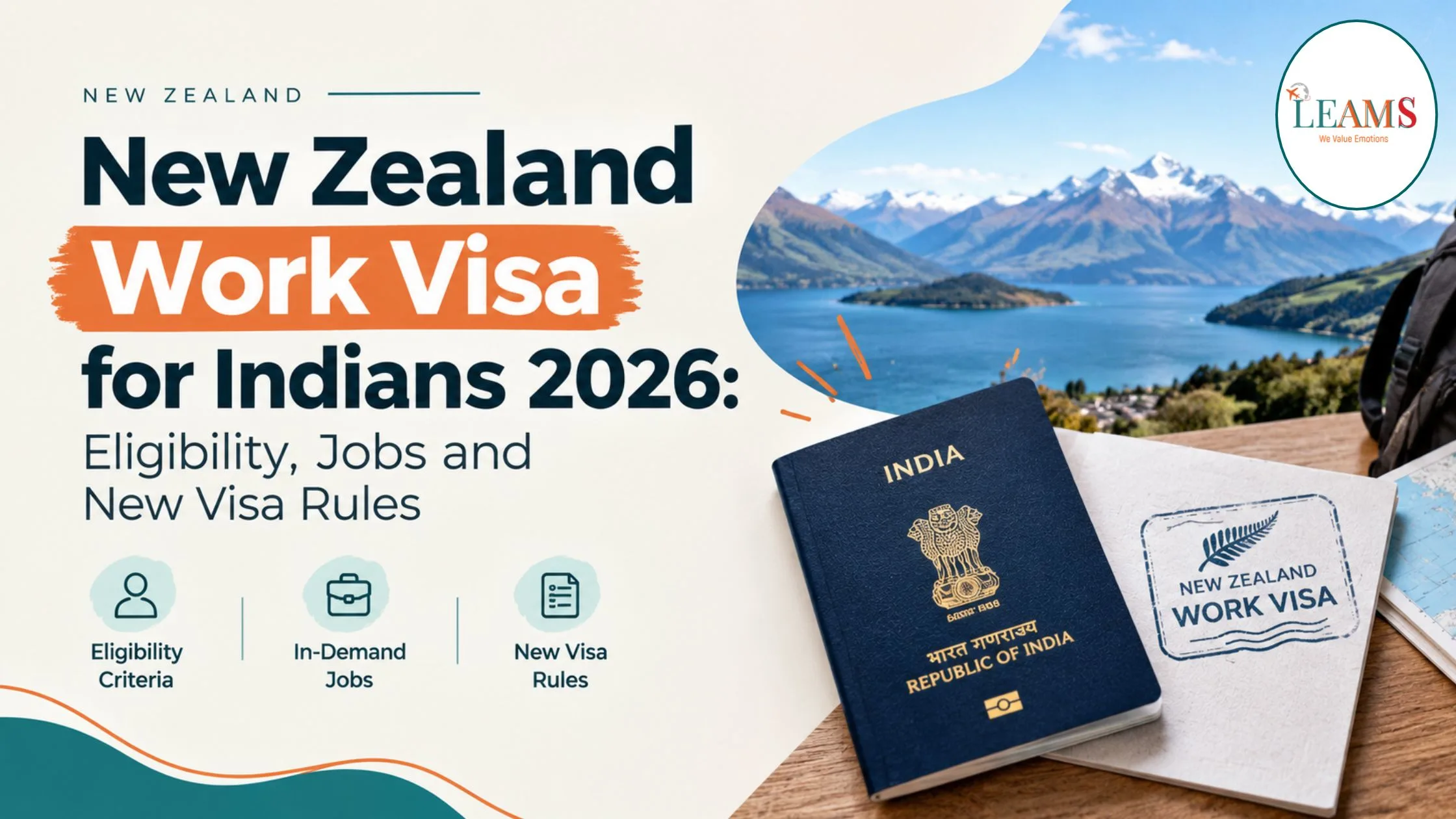
Planning to work in New Zealand from India? A new immigration development has created two additional work visa options for eligible Indian citizens. If you have been searching for a New Zealand work visa for Indians, this is an important update to understand before making your next move.
The India–New Zealand Free Trade Agreement (FTA) came into force on 20 October 2026. Under the new arrangements, eligible Indian citizens can explore two specific temporary work visa categories: the India Skilled Work Visa and the India Iconic Work Visa.
However, these options are not open to everyone. You need a qualifying job offer, and your occupation, qualifications, work experience and English language ability must meet the relevant requirements.
In this guide, we explain the new rules, eligible occupations, visa fees, English test scores, required documents and the difference between a temporary work visa and a pathway to residence.
What Is the New Zealand Work Visa Update for Indians in 2026?
New Zealand introduced two temporary work visa categories for eligible Indian citizens on 20 October 2026.
- India Skilled Work Visa: For eligible professionals with a qualifying job offer in an approved occupation, such as software engineering, selected engineering roles, teaching, nursing and physiotherapy.
- India Iconic Work Visa: For eligible Indian chefs, yoga instructors, music teachers and practitioners in specified AYUSH fields.
Both visas can allow a stay of up to three years, depending on the job offer and visa conditions. Applicants must meet the relevant qualification, work experience, English language, health and character requirements.
The maximum number of visa holders at any one time is 5,000 across both categories: 4,400 under the India Skilled Work Visa and 600 under the India Iconic Work Visa.
Important: These are temporary work visas. They do not provide a direct pathway to New Zealand residence, and meeting the basic eligibility requirements does not guarantee approval.
Official sources:
India Skilled Work Visa — Immigration New Zealand
India–New Zealand Free Trade Agreement: Visa Commitments
1. What Changed in New Zealand Immigration on 20 October 2026?
The India–New Zealand Free Trade Agreement introduced new temporary work visa arrangements alongside other commitments relating to students and working holiday opportunities.
For Indian professionals, the main change is the introduction of dedicated visa categories for selected skilled occupations and certain professions associated with Indian culture and traditional practices.
This does not mean that New Zealand has introduced an unrestricted work visa for every Indian citizen.
You still need to qualify under the relevant category and secure a suitable job offer from an accredited New Zealand employer.
If you are researching a New Zealand visa for Indians, it is important to identify which visa matches your purpose. A temporary work visa, a student visa and a residence visa have different eligibility rules and conditions.
2. India Skilled Work Visa: Which Jobs Are Eligible?
The India Skilled Work Visa is designed for eligible Indian citizens who have a qualifying job offer in one of the approved occupations.
Immigration New Zealand groups the available places by occupation sector. The allocation is not a separate quota for every individual job title.
Approved occupations and visa allocations
| Approved occupation group | Maximum allocation |
| Software engineers, software and applications programmers, and ICT project managers | 1,000 |
| Civil, mechanical, structural and environmental engineers | 1,000 |
| Construction and building project managers | 700 |
| Primary and secondary school teachers | 500 |
| Registered nurses | 900 |
| Physiotherapists | 300 |
| Total | 4,400 |
These figures represent the maximum number of visa holders permitted across the listed sectors at any one time. They are not a promise that every applicant will receive a visa.
Immigration New Zealand stated that all places were available as of 20 October 2026. Applicants should check the official visa page for the latest availability before applying.
Can IT professionals apply for a New Zealand work visa?
Potentially, yes. Software engineers, software and applications programmers, and ICT project managers are included in the approved occupation groups.
However, having an IT degree or working in the technology sector is not enough by itself. Your actual role, qualifications, relevant experience and job offer must meet the applicable requirements.
For example, an Indian software engineer should first check whether the proposed New Zealand position falls within the approved occupation list. The next step is to confirm the required qualifications and experience and identify an accredited employer offering a qualifying position.
What about engineers, nurses and teachers?
Selected engineering occupations, registered nurses, physiotherapists, primary school teachers, secondary school teachers and eligible construction project managers are also covered.
Some occupations may require professional registration or recognised qualifications. Overseas qualifications may also need an International Qualifications Assessment (IQA) from the New Zealand Qualifications Authority (NZQA), unless an applicable exemption applies.
Before paying for an assessment, check the official requirements for your exact occupation.
Official source: India Skilled Work Visa — eligible jobs and requirements
3. India Iconic Work Visa: Who Can Apply?
Not every person looking for work overseas belongs to a conventional skilled occupation. The India Iconic Work Visa covers a smaller group of professions associated with Indian cuisine, yoga, music and traditional medicine.
The approved occupations and maximum allocations are:
| Occupation | Maximum allocation |
| Indian chefs | 250 |
| Yoga instructors | 100 |
| Music teachers | 50 |
| AYUSH practitioners in approved fields | 200 |
| Total | 600 |
The qualification and experience requirements depend on the occupation.
Indian chefs
Applicants need a tertiary-level qualification in Indian cuisine involving at least two years of successful study at an institution recognised by the Indian Federal Government. They must also have at least two years of relevant work experience gained after completing the qualification.
Yoga instructors
Applicants need a recognised bachelor's degree in yoga from an institution recognised by the Indian Federal Government.
Music teachers
Applicants need a bachelor's degree or an equivalent three-year tertiary qualification in music, together with at least two years of relevant work experience as a music teacher after gaining the qualification.
An International Qualifications Assessment from NZQA is required where specified for an overseas music qualification.
AYUSH practitioners
Eligible fields include Ayurveda, naturopathy, Unani, Siddha, Sowa Rigpa and homeopathy, subject to the detailed official requirements.
Applicants must hold the appropriate recognised qualifications and meet the relevant experience requirements.
A short course or general certificate should not be assumed to meet the requirements. Check the exact qualification rules for your profession before preparing an application.
Official source: India Iconic Work Visa — Immigration New Zealand
4. Can Indians Apply for a New Zealand Work Visa Without a Job Offer?
No. Both the India Skilled Work Visa and the India Iconic Work Visa require a qualifying job offer.
For your first visa under either category, you must generally be outside New Zealand when you apply.
Your job offer must be current when you apply, provide at least 30 hours of work a week, and come from an employer accredited under New Zealand's Accredited Employer Work Visa policy. The job must also be included in the approved occupation list for your chosen category.
Before accepting an offer, review:
- The employer's identity and accreditation status.
- Your job title and actual responsibilities.
- Your salary, working hours and employment agreement.
- The qualifications, experience or professional registration required.
- Whether the position genuinely meets the relevant visa rules.
Be careful with anyone promising a guaranteed New Zealand job or visa in exchange for money. Immigration New Zealand warns that offering or promising money to an employer or their agent in exchange for a job offer can result in a visa application being declined.
A genuine job offer should be independently verifiable. Do not make payments or commitments based only on a recruitment message or verbal promise.
5. How Long Can You Stay in New Zealand?
Both new visa categories can allow you to stay for up to three years. The actual duration depends on the length of the qualifying job offer and the visa conditions.
The three-year period is a combined limit across the India Skilled Work Visa and India Iconic Work Visa arrangements.
If your first visa is granted for less than three years, you may be able to apply for another visa under the same category to use the remaining permitted time, subject to the rules.
Once you have reached the three-year limit, you must spend at least three years outside New Zealand before qualifying for another visa under either of these categories.
While in New Zealand, you can work only in the job, for the employer and at the location specified by your visa. These visas also permit study for up to three months in any 12-month period, subject to the applicable conditions.
Do not plan your stay around the maximum duration alone. Read the conditions attached to your own visa.
6. New Zealand Work Visa Fees for Indians in 2026
Immigration New Zealand lists the starting application cost for both the India Skilled Work Visa and the India Iconic Work Visa as NZD 1,355.
| Visa category | Published starting cost | Maximum stay |
| India Skilled Work Visa | NZD 1,355 | Up to 3 years |
| India Iconic Work Visa | NZD 1,355 |
Up to 3 years |
These are starting costs, not a guarantee of the total amount you will spend.
Your overall expenses may include English tests, medical examinations, document translations, qualification assessments where required and other preparation costs.
Before submitting an application, use the official visa page to confirm the current fee and any applicable charges. Fees and requirements can change.
Official sources:
7. What English Test Score Is Required?
Applicants must provide acceptable evidence that they can speak and understand English. The required score depends on the visa category and, for the India Iconic Work Visa, the occupation.
The test must be taken in person at an acceptable test centre. Results must be no more than two years old when you apply. Remote tests taken at home are not accepted under the published requirements.
English requirements for the India Skilled Work Visa
| Accepted test | Minimum score |
| IELTS Academic or General Training | Overall 6.5 |
| TOEFL iBT | Overall 79 |
| PTE Academic | Overall 58 |
| Cambridge B2 First or B2 First for Schools | Overall 176 |
| OET | Grade C+ or higher in all four skills |
English requirements for the India Iconic Work Visa
| Occupation | IELTS | TOEFL iBT |
PTE Academic |
Cambridge B2 First |
| Yoga instructor |
At least 5.0 in listening and speaking |
Listening 12; speaking 14 |
At least 36 in listening and speaking | At least 154 in listening and speaking |
| Indian chef | At least 5.0 in listening and speaking | Listening 12; speaking 14 |
At least 36 in listening and speaking | At least 154 in listening and speaking |
| Music teacher | Overall 6.5 | Overall 79 | Overall 58 | Overall 176 |
| AYUSH practitioner | Overall 6.5 | Overall 79 | Overall 58 | Overall 176 |
Check the official English-language requirements page before booking a test, as the accepted evidence and scores must match your visa category.
Official source: English language requirements for India work visas
8. Documents Required for a New Zealand Work Visa
Preparing your documents early can make the application process easier. The exact checklist depends on your occupation and personal circumstances, so use the official checklist for your visa.
Documents may include:
- A valid Indian passport and acceptable photograph.
- A signed job offer.
- Your employment agreement and job description.
- Educational certificates and academic transcripts.
- Evidence of relevant work experience.
- English language test results.
- Professional registration evidence, if required.
- An International Qualifications Assessment, where applicable.
- Police certificates, where required.
- Medical examination and chest X-ray evidence, where required.
- Certified English translations of documents that are not in English.
How can you prove your work experience?
Depending on the occupation, supporting evidence may include employment certificates, payslips, tax certificates and employer references.
Employment certificates should contain verifiable information about your position, employment dates and employer contact details.
Your job description should clearly explain your duties and responsibilities. A job title alone may not be sufficient to establish that your experience matches the occupation requirements.
Do you need a medical examination?
Applicants must meet the applicable health requirements. Medical examinations and chest X-rays may be required, and Immigration New Zealand specifies when the relevant certificates must be completed.
Do you need a police certificate?
Police certificates are required in specified circumstances. For these visa categories, applicants aged 17 or older whose total stay in New Zealand will be 24 months or longer generally need to provide police certificates, subject to the official rules and any applicable exceptions.
Check the official document checklist for the requirements that apply to you.
9. How to Apply for the India Skilled Work Visa or India Iconic Work Visa
Once you have confirmed that your occupation is covered, follow the application instructions published by Immigration New Zealand.
Step 1: Check your occupation
Identify the correct visa category and confirm that your occupation is on its approved list.
Step 2: Find a qualifying job
Secure a genuine, current job offer from an accredited employer. Check that the position meets the relevant hours and occupation requirements.
Step 3: Review your qualifications and experience
Confirm that your qualifications, work experience and professional registration meet the requirements for your proposed role.
Step 4: Complete your English test and prepare documents
Arrange an accepted English test if required, and collect the evidence needed for your application. Check medical, police certificate and translation requirements.
Step 5: Check places and fees
Confirm that places remain available in the relevant category and review the current application cost.
Step 6: Submit your application
Follow the application instructions on the official visa page and provide the required supporting documents and payment.
Step 7: Wait for the decision
Immigration New Zealand may request additional information. Do not assume approval until a decision has been made.
Official application pages:
Apply for the India Skilled Work Visa
Apply for the India Iconic Work Visa
10. Does the New Zealand Work Visa Lead to PR?
This is one of the most important questions to consider before choosing a visa.
The India Skilled Work Visa and India Iconic Work Visa do not provide a direct pathway to New Zealand residence. Completing three years on either visa does not automatically make you eligible for permanent residence.
If your long-term goal is to settle in New Zealand, you should separately examine the requirements for an appropriate residence category, such as the Skilled Migrant Category Resident Visa or an applicable Work to Residence pathway.
There is another important restriction. Time spent on these new visas cannot be counted as skilled work experience for certain residence pathways, including the Skilled Migrant Category Resident Visa and specified Work to Residence categories.
This means you should not assume that working in New Zealand under one of these arrangements will automatically help you meet the skilled work experience requirements for residence.
If your primary goal is New Zealand PR, compare the conditions of the temporary work visa with the current rules for the residence category you may eventually want to pursue.
Official source: India–New Zealand FTA visa commitments
11. Can Applicants from Mumbai and Thane Apply?
Yes, eligible Indian citizens living in Mumbai, Thane or elsewhere in India can explore these visa categories.
Your city does not determine your eligibility. You must meet the same applicable national immigration requirements as other Indian citizens.
If you are researching a New Zealand work visa from Mumbai or Thane, a sensible starting point is to:
Check whether your occupation is approved.
Review the qualification and experience requirements.
Search for genuine job opportunities with accredited employers.
Check the English language and document requirements.
Understand the temporary nature of the visa and the separate rules for residence.
Before spending money on recruitment, qualification assessments or application preparation, make sure the visa is suitable for your circumstances.
Final Thoughts
The new India–New Zealand work visa arrangements may be worth exploring if your occupation is covered and you can secure a qualifying job offer.
But the right starting point is not simply to apply because a new visa has been announced. Check your occupation, qualifications, experience, English language requirements and the employer's eligibility first.
If your goal is to settle in New Zealand permanently, make sure you understand the difference between a temporary work visa and a residence pathway before making a decision.
A well-informed decision begins with the official rules and a realistic assessment of your own profile.
Official information and disclaimer
This article is based on Immigration New Zealand's published visa information and the India–New Zealand Free Trade Agreement announcement available as of 22 October 2026. Visa rules, fees, available places and eligibility requirements may change. Always check the latest official guidance before applying. This article is for general information only and does not constitute immigration or legal advice.