"Your Marks Are Too Low to Study Abroad." — Here Is Why That Is Wrong, and What to Do Instead
Someone told you your marks were not good enough. Maybe it was a relative. Maybe it was a neighbour who "knows someone who went abroad." Maybe it was an agent who looked at your profile for thirty seconds and said no. And somewhere between that conversation and this Google search, you started believing it.
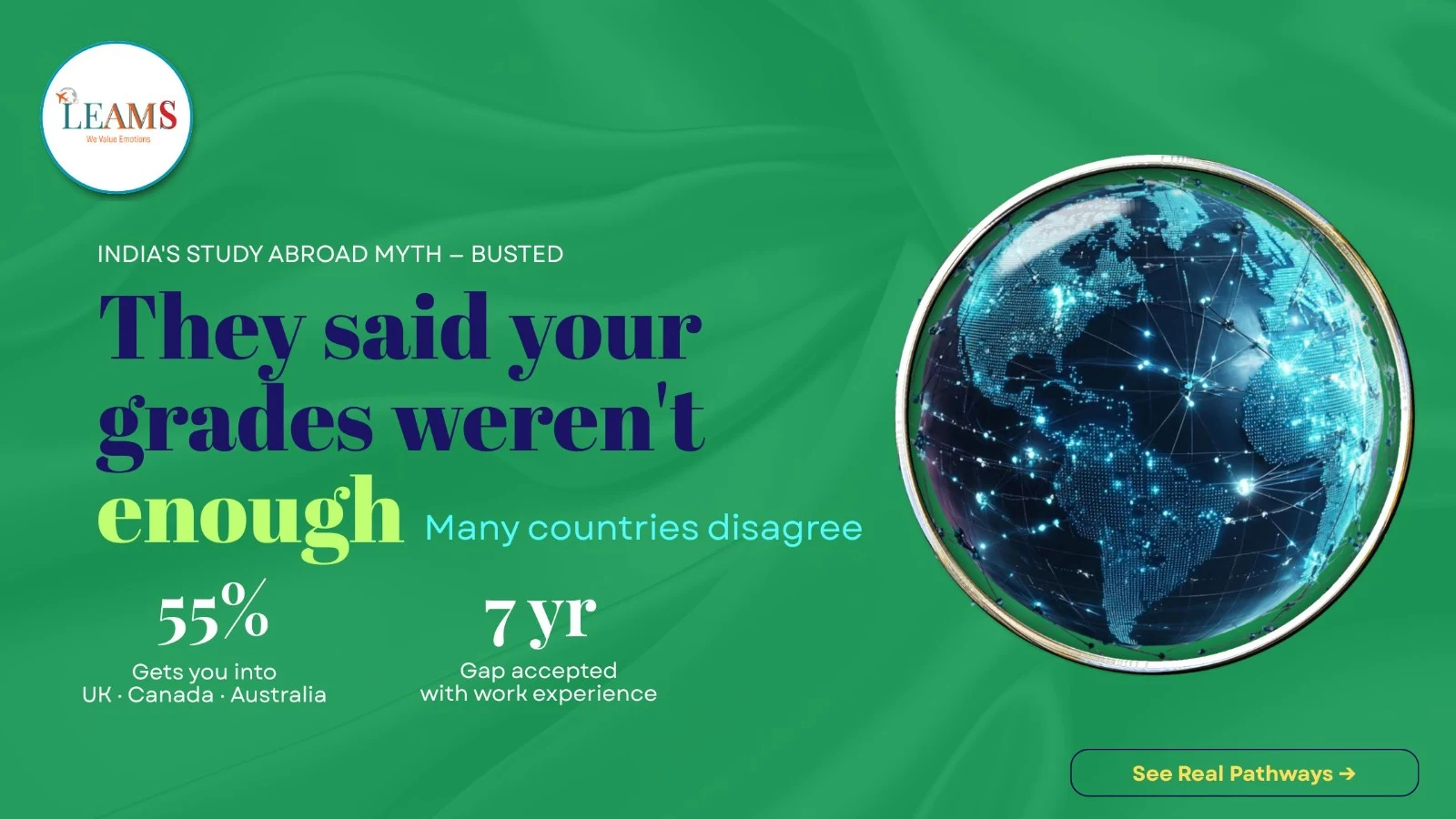
Here is what that person did not tell you: foreign universities do not think the way people around you do. Every year, thousands of Indian students with 55% marks, 3-year gaps, backlogs, and career breaks get accepted into universities across the UK, Canada, Australia, Ireland, Germany, and eight other countries — and many of them go on to build careers, work permits, and permanent residency from scratch.
The problem was never your profile. The problem was the advice.
The Myth That Is Quietly Killing Thousands of Study Abroad Dreams in India
- Foreign universities look at your overall profile, not just one number.
- A gap of 2, 3, even 5+ years is not an automatic disqualification.
- Many countries actively welcome students who have taken time to grow, work, or upskill.
- "Low grades" is a relative term - what feels low in India may be perfectly acceptable abroad, especially when supported by other strengths.
What Foreign Universities Actually Look At — and It Is Not What You Think
What they really evaluate
- Your academic trend (improvement over years matters)
- English proficiency scores (IELTS, PTE, TOEFL, Duolingo)
- Work experience, internships, or freelance work
- Online courses and certifications (Coursera, Google, AWS, etc.)
- Volunteering, leadership roles, and extracurriculars
- A strong Statement of Purpose (SOP) explaining your story
- Letters of recommendation
Why a gap year isn't a red flag abroad
Pathway and foundation programs exist for a reason
How to Turn a "Weak" Profile Into a Genuine Admit — Step by Step
Your profile is a story. Your job is to tell that story well.
1. Show how you used your time
- Did you work full-time or part-time?
- Did you help in a family business?
- Did you prepare for competitive exams?
- Did you take care of a family member?
- Did you travel, volunteer, or freelance?
2. Build skills that universities respect
Use the time before your application to strengthen your profile:
- Complete online certifications in your field (Google, Microsoft, Coursera, edX, HubSpot)
- Take up internships, even unpaid or remote ones
- Start a small freelance portfolio if you're in design, writing, marketing, or tech
- Improve your English score — a strong IELTS/PTE can offset weaker academics
3. Craft a powerful Statement of Purpose
Your SOP is where low grades and gaps get explained, not hidden. A good SOP:
- Acknowledges weaknesses honestly
- Shows growth and self-awareness
- Connects your past to your future goals
- Demonstrates clarity about the course and country
4. Choose the right country and course
This is where most students go wrong. Applying to ultra-competitive universities with a weak profile leads to rejection. Choosing the right-fit country and program dramatically increases your chances.
Country-Wise Pathways for Students With Low Grades or Gap Years
| Country | Pathway Options Available | Minimum Academic Acceptance | Gap Year Acceptance | Post-Study Work Rights | Key Advantage |
| United Kingdom (UK) | Foundation Year (1 year), Pre-Master's programs | 50–55% in undergrad | Up to 10 years with valid reasons | 2 years (Graduate Route Visa) | Highly flexible entry requirements and well-structured bridging programs |
| United States (USA) | Community colleges (2-year associate degrees), Conditional admissions, Pathway programs | Varies; flexible with conditional offers | Accepted if explained well in SOP | 1–3 years (OPT, extended for STEM) | Community college route transfers easily into top universities |
| Canada | College diplomas, PG Diplomas (1–2 years) | 55–60% in academics | Accepted, especially with work experience | Up to 3 years (PGWP) | Direct route to PR after studies and work experience |
| Ireland | Foundation programs, Pre-Master's pathways | Average grades accepted with good English scores | Generally flexible with valid reasons | 2 years stay-back option | Affordable, English-speaking, and generous post-study option |
| Australia | Diploma-to-degree pathways | 55%+ in academics | Up to 7+ years with work experience | 2–6 years post-study work visa | Strong work rights and clear PR pathways |
| Singapore | Private universities, career-focused institutes | Average academic profiles accepted | Recognises work experience strongly | Varies by program/employer | Recognises online certifications and industry experience |
| Netherlands | Applied Sciences universities, English-taught programs | Flexible at Applied Sciences leve | Gaps with work/internships welcomed | 1-year Orientation Year Visa | Affordable tuition and globally respected degrees |
| Germany | Studienkolleg (Foundation Year) | For students who don't qualify directly | Accepted with valid explanation | 18-month job-seeker visa | Low or no tuition fees at public universities |
| New Zealand | Diploma pathways, foundation programs | Flexible academic entry | Accepted with relevant experience | Up to 3 years post-study work visa | Easy diploma-to-degree-to-PR transition |
| France & Spain | English-taught business and | Flexible entry, especially in | Generally accepted | 1–2 years post-study stay-back | Affordable, multicultural exposure in Europe |
This Is Not Just About a Degree — It Is About Building a Life Abroad
Conclusion
(FAQs) Study abroad with low grades and gap year :-
Q.1 Will a 5-year gap stop me from getting a student visa?
Q.2 Can you study abroad during a gap year?
Q.3 Is it harder to get accepted after a gap year in 2026?
No — many universities in Australia, Canada, and United Kingdom accept students with gap years if they can clearly explain how they used that time for work, skills, or personal growth.
Q.4 Do I need work experience to cover my gap?
Not always. Internships, freelancing, volunteering, family business work, or even structured self-study can be acceptable explanations.
Q.5 Can I settle abroad permanently after a diploma or pathway program?
Absolutely. Many students start with diplomas, move into degrees, gain work experience, and eventually apply for PR through skilled-worker or graduate routes.