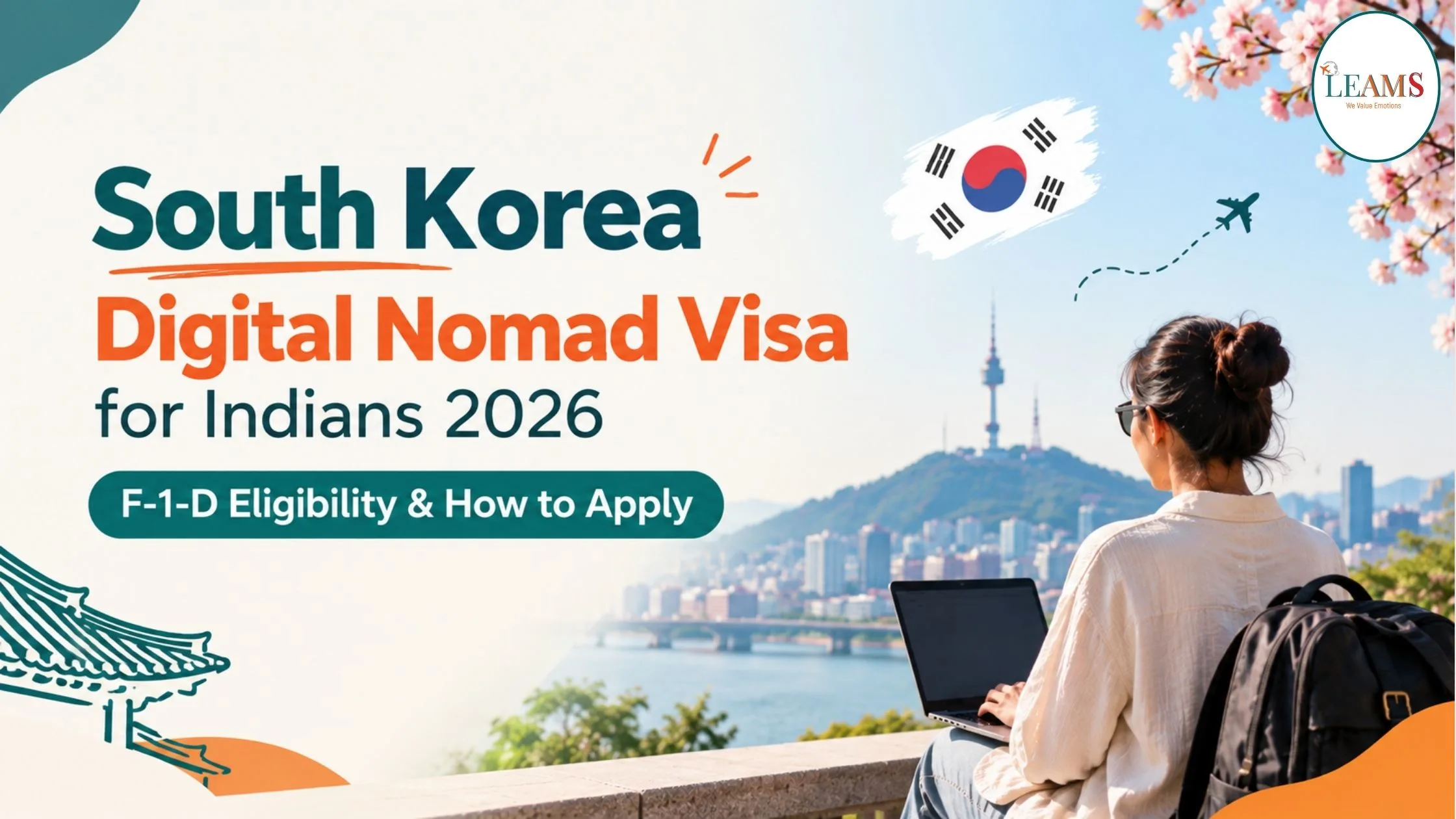
If you are an Indian remote professional looking to live and work from South Korea, the South Korea Digital Nomad Visa for Indians, officially known as the F-1-D Workation Visa, may allow you to stay in Korea while continuing your overseas employment or business.
South Korea introduced the F-1-D visa as a pilot programme in January 2024. The Ministry of Justice made the visa a permanent visa category from 30 June 2026, with revised stay and income rules.
|
Quick Summary (TL;DR): The South Korea F-1-D Digital Nomad Visa is designed for foreign remote workers and business owners who earn their income from outside South Korea. Important: Income thresholds and application requirements can change. Applicants should check the latest Korean government requirements before submitting an application. |
What Is the South Korea F-1-D Digital Nomad Visa?
The F-1-D Workation Visa allows eligible foreign remote workers to live in South Korea while continuing to work for an overseas employer or operate an overseas business.
The programme was originally introduced as a pilot on 1 January 2024. From 30 June 2026, South Korea converted the F-1-D Workation Visa into a permanent visa category.
The visa is intended for people who want to combine remote work with longer-term living in South Korea, rather than simply visit the country as tourists.
Is the South Korea Digital Nomad Visa Available to Indians?
Yes. Indian citizens can apply for the F-1-D visa if they meet the eligibility requirements.
The programme is not limited to a particular nationality. Eligibility is primarily based on the applicant's:
- Employment or business status
- Professional experience
- Income
- Criminal record
- Health insurance
- Intended stay in South Korea
For an Indian applicant, the important point is that the employer or business must be based outside South Korea.
South Korea F-1-D Visa Eligibility 2026
To qualify for the F-1-D Workation Visa, applicants generally need to satisfy the following conditions.
1. Work for an Overseas Company or Run an Overseas Business
You should be employed by a company located outside South Korea or operate a business established outside South Korea.
The visa is intended for remote work, so applicants should not use the F-1-D visa to take employment with a Korean company.
2. Professional Experience
Applicants generally need to demonstrate at least one year of experience in the relevant industry or field.
Employment certificates, business records and other supporting documents may be used to demonstrate professional experience.
3. Meet the Income Requirement
Applicants must demonstrate income above the applicable F-1-D threshold.
The 2026 system uses different thresholds depending on:
- Applicant's age
- Where the applicant plans to live in South Korea
This means there is not one single income figure that applies to every applicant.
4. Criminal Record Requirement
Applicants need to satisfy South Korea's criminal-record requirements and provide the relevant documentation where required.
5. Health Insurance
Applicants need appropriate private medical insurance covering their stay in South Korea.
The Korean government requirements include a minimum level of medical coverage, so applicants should verify the current insurance requirements before applying.
F-1-D Income Requirement 2026
The income requirement is one of the most important parts of the 2026 F-1-D rules.
South Korea has changed the previous single-threshold approach and now applies different income levels based on age and residence area.
The threshold is linked to South Korea's Gross National Income (GNI) per capita.
2026 F-1-D Income Structure
| Applicant | Seoul Metropolitan Area | Eligible non-metropolitan |
| 18–34 years | 1.5× GNI | 1× GNI |
| 35+ years | 2× GNI | 1.5× GNI |
The exact Korean won amount should be checked against the latest official GNI figure applicable at the time of application.
Why Location Matters
This is an important change for younger applicants.
An eligible applicant aged 18–34 who plans to live outside the Seoul metropolitan area may fall under the 1× GNI threshold, while an applicant in the Seoul metropolitan area would generally need to meet the higher 1.5× threshold.
Therefore, applicants should not assume that the standard 2× GNI figure applies to everyone.
What Counts as the Seoul Metropolitan Area?
For the purpose of the relevant residence-based rules, the Seoul metropolitan area includes:
- Seoul
- Incheon
- Gyeonggi Province
Applicants planning to live elsewhere should check whether their intended location falls within the areas eligible for the lower threshold under the current government rules.
Documents Required for the F-1-D Visa
Indian applicants should prepare documents demonstrating their identity, employment, income and eligibility.
Common documents may include:
- Valid passport
- Visa application form
- Recent passport-size photograph
- Employment certificate or proof of overseas business
- Proof of professional experience
- Income documents
- Salary slips or tax records
- Bank statements, where applicable
- Criminal record certificate
- Health insurance certificate
- Proof of family relationship for accompanying family members
- Other documents requested by the Korean immigration authorities or visa office
Document requirements can vary depending on the applicant's circumstances and place of application.
How to Apply for the South Korea Digital Nomad Visa from India
The application process can be broadly understood in these steps.
Step 1: Check Your Eligibility
First, check:
- Your age
- Overseas employment/business
- Professional experience
- Annual income
- Intended Korean residence
- Criminal record requirements
- Insurance coverage
Step 2: Prepare Supporting Documents
Collect your employment, income, financial, insurance and personal documents.
Make sure your documents are current and meet the required format.
Step 3: Submit the Visa Application
Indian applicants should submit their application through the appropriate Korean diplomatic mission or authorised visa application channel applicable to their location.
Always confirm the current submission procedure before visiting the visa office because procedures can change.
Step 4: Wait for the Visa Decision
Processing time depends on the application and the relevant Korean authority.
For this reason, applicants should avoid making non-refundable travel arrangements until the visa decision is confirmed.
Step 5: Complete Registration After Arrival
If you stay in South Korea for more than 90 days, immigration registration requirements may apply.
Eligible applicants should complete the required registration within the prescribed period after arrival.
Can You Work for a Korean Company on an F-1-D Visa?
No.
The F-1-D visa is intended for remote work connected to an overseas employer or business.
It should not be treated as a general Korean employment visa.
If you want to work for a South Korean employer, you may need to qualify for a different Korean work visa.
Can Your Family Join You?
Yes. Eligible spouses and minor children may accompany the main F-1-D visa holder, subject to the applicable immigration requirements.
However, family eligibility does not mean that the spouse's income can automatically be added to the main applicant's income to satisfy the F-1-D income threshold.
The main applicant should independently meet the applicable financial requirement.
Does the Korea Digital Nomad Visa Lead to Permanent Residency?
No, not directly.
The F-1-D is designed as a long-stay visa for eligible remote workers and their families.
Holding an F-1-D visa does not automatically give the applicant permanent residence or Korean citizenship.
Anyone interested in eventually settling in South Korea should separately review the eligibility requirements for other long-term residence or settlement visa categories.
F-1-D Visa vs Tourist Visa
The two visas serve different purposes.
| F-1-D Digital Nomad Visa | Tourist Visa/Entry |
| Designed for eligible remote workers | Designed primarily for tourism/short visits |
| Long-term stay | Generally shorter stay |
| Overseas remote employment/business permitted | Work is not permitted |
| Income and professional requirements apply | Different entry requirements |
| Family accompaniment may be possible | Depends on applicable visitor rules |
If your main purpose is to live in Korea while continuing your overseas remote job, the F-1-D category is more relevant than treating a tourist stay as a remote-work arrangement.
Is the South Korea Digital Nomad Visa Right for Indian Remote Workers?
The F-1-D visa may be relevant if you:
- Work remotely for a company outside South Korea
- Run an overseas business
- Have the required professional experience
- Meet the applicable income threshold
- Want to live in Korea for an extended period
- Do not intend to take local employment
Before applying, check your age, income, employment structure and intended Korean residence, because these factors can affect eligibility.
Final Takeaway
The South Korea Digital Nomad Visa for Indians 2026 provides an option for eligible remote professionals who want to live in South Korea while continuing their overseas employment or business.
The most important points to check are F-1-D eligibility, professional experience, income, intended residence, insurance and overseas employment/business status.
Because Korean immigration requirements can change, applicants should verify the latest requirements with the Korean Ministry of Justice, Korea Immigration Service and the relevant Korean diplomatic mission in India before applying.
For profile-specific guidance on eligibility and documentation, you can contact LEAMSS.
📞 7718882427
🌐 leamss.com
📧 Ladhani@leamss.com
📍 Thane