Australia Student Visa Rejection Reasons for Indians 2026: Why 40% Get Refused

Australia student visa rejection 2026 — 7 reasons Indian students get refused and how to fix each one before applying

Australian student visas get refused for Indians mainly because of seven reasons: a course that doesn't match your background, a generic Genuine Student (GS) statement, unclear finances, incomplete documents, a weak English score, an application that looks work- or PR-focused, and a late application or the wrong provider. As of February 2026, 40% of student visa applications from India were refused, the highest rate in over 21 years, according to Australia's Department of Home Affairs.

The 7 reasons at a glance:

1. Your course doesn't connect to your past study or work
2. Your Genuine Student (GS) statement is generic
3. Your funds are unclear or can't be traced
4. Your documents are incomplete or outdated
5. Your English score is below or borderline to the current requirement
6. Your application looks work-focused instead of study-focused
7. You applied late or chose a high-risk provider

The dream of studying in Australia has not changed, but the path to get there has. Student visa approvals are at their lowest point in over two decades, and India was moved to Evidence Level 3 (EL3), the highest-risk category, from 8 January 2026. The Department of Home Affairs now looks far beyond your offer letter. Under the Genuine Student requirement introduced in March 2024, your course choice, finances, English score and reasons for studying abroad must all tell one clear, consistent story. If even one piece feels out of place, the visa can be refused. This is not because you are undeserving, but because the application did not show the full picture.

This guide explains each Australia student visa rejection reason in detail and shows exactly how to fix it before you apply. Whether you are applying for the first time or reapplying after a refusal, use it to build a stronger application in 2026 and beyond.


Australia Student Visa Refusal Rate by Country (February 2026)

Here is the latest country-wise data for offshore higher education student visa applications, from the Australian Department of Home Affairs.
 
Country Rejection Rate (Feb 2026)
Nepal 60–65%
Bangladesh 47–51%
India 40%
Sri Lanka 38%
Bhutan 36%
China 3%
 

Source: Australian Department of Home Affairs data (February 2026), as reported by ICEF Monitor and Business Standard.

Key facts from the latest data:

- Overall higher education visa approval rate in February 2026: 67.6%, the lowest monthly grant rate in at least 21 years
- Total student visas granted in January and February 2026: 34,000, the lowest since 2013 outside the COVID period
- India was moved to Evidence Level 3 (EL3), the highest-risk category, from 8 January 2026
- Applications from India rose about 36% compared with February 2025, even as refusals increased
- For the first three months of 2026, India's offshore higher education refusal rate was around 42%

More Indians are applying and more are being refused. Stricter checks on the Genuine Student requirement, funds and documents mean weak or inconsistent applications are far more likely to fail, so preparation matters more than ever.


Why Is Australia Rejecting So Many Indian Student Visas?

The short answer is this -  the application has not kept up with the rules.
Australia introduced the Genuine Student (GS) requirement in March 2024, replacing the older Genuine Temporary Entrant (GTE) framework. On the surface, the change sounds technical. In practice, it completely shifted what visa officers look for. They are no longer just checking whether your documents are present. They are reading your entire application as a story — and asking one central question: does this person genuinely want to study, or are they using a student visa for another purpose?
When that story has gaps — a course that does not connect to your background, finances that are hard to trace, or a personal statement that sounds copy-pasted — the application raises doubt. And doubt, in 2026, leads to refusal.
The good news is that most of these gaps are fixable. Here are the seven most common reasons Indian students are getting refused — and exactly what to do about each one
 

What Is Evidence Level 3 (EL3) for Indian Students?

From January 8, 2026, India was moved from Evidence Level 2 (EL2) to Evidence Level 3 (EL3) under Australia's Simplified Student Visa Framework. This was confirmed by the Indian government in Parliament on April 3, 2026.
EL3 is the highest-risk classification in the framework. It means:
  • More detailed financial documentation required
  • Stronger proof that primary purpose is study
  • Longer processing times possible
  • Higher chance of additional scrutiny on every document submitted
This reclassification does not ban Indian students from applying — but it does mean a weak or average application that may have been approved in 2024 will very likely be refused in 2026.
 

7 Australia Student Visa Rejection Reasons for Indians (2026)


1. Course Doesn't Match Your Background

If your chosen course has no clear link to your past studies or work experience, visa officers will question your intent. A Commerce graduate applying for a Hospitality certificate with no explanation is a red flag, not because the course is wrong, but because the story is missing.

Since India moved to Evidence Level 3 (EL3) in January 2026, course and background alignment is likely to be looked at more closely for Indian applicants. Write a short, clear explanation of why you chose this course, why now, and how it connects to your career plan. It is strongly recommended, and it is one of the simplest ways to strengthen your Genuine Student statement.


2. Your Genuine Student (GS) Statement Is Too Generic

Lines like "Australia has a world-class education system" add nothing to your application, because they could be written by any applicant. Visa officers read a large number of GS statements, and they are looking for evidence that your decision is your own.

A strong GS statement is specific to you. It should explain your background, why you chose this course and this institution, how you will fund your studies, and what you honestly plan to do after graduation. Every claim should match your documents. A vague or copied statement does not just fail to impress, it can raise doubt about your genuine intent.


3. Unclear or Unverifiable Funds

A large bank balance does not help if visa officers cannot trace where the money came from. Sudden deposits, income documents that do not match, or an unclear sponsor relationship are all red flags. Your financial story should be simple, transparent and fully supported. It must show not only that the funds exist, but also that they are genuinely available for your studies.


4. Incomplete or Outdated Documents

Since January 2025, onshore applicants can no longer use a Letter of Offer. A current Confirmation of Enrolment (CoE) is mandatory. Beyond that, mismatched identity documents, missing OSHC coverage or uncertified translations can delay or sink an application. Check the official Home Affairs Document Checklist before you lodge, every single time.


5. English Score Below the Current Requirement

Australia raised the minimum student visa English requirement from IELTS 5.5 to IELTS 6.0 in March 2024. Since India is an EL3-classified country, Indian applicants are expected to provide stronger English evidence, and a borderline score of exactly 6.0 may face more scrutiny than in previous years. Aiming for IELTS 6.5 or higher significantly reduces this risk.

Also check that your test is still valid and accepted. The list of approved English tests was updated in August 2025. If your score is borderline, your test has expired or your test provider is no longer approved, your application has a problem before a visa officer even reads it.


6. Your Application Looks Work-Focused Instead of Study-Focused

Student visa holders can work up to 48 hours per fortnight, but work cannot be the reason you are applying. If your personal statement, course choice and overall story revolve around job opportunities or permanent residency, visa officers will question your genuine intent. Keep your application study-led, with career outcomes that make sense, and not migration hopes presented as academic goals.


7. You Applied Late or Chose a High-Risk Provider

Under Ministerial Direction 115 (effective November 2025), offshore applications are processed based on your education provider's allocation threshold. This means your timing and your choice of provider directly affect how quickly your file moves. A rushed, last-minute application with an unfamiliar provider adds unnecessary risk. Apply early, choose your provider carefully and give your file enough preparation time.

If you are still choosing a course or provider, read our guide on how to study in Australia as an Indian student before you shortlist universities.


Weak vs Strong Australia Student Visa Application

What a risky application looks like What a strong application looks like
Course has no clear link to past study or work Course progression is logical and well-explained
GS statement uses generic, copied language Statement is personal, specific, and evidence-backed
Finances show large unexplained deposits Funding is transparent, traceable, and documented
Documents are incomplete or use old formats Full document set is current and decision-ready
English evidence is borderline or from an outdated test Score meets current requirements from an accepted test
Application focuses on work or PR outcomes Study is clearly positioned as the primary purpose
Filed late with little preparation Filed early with a thoroughly prepared file


Subclass 485 Fee Increase 2026: What Indian Students Should Know

Effective 2026, Australia doubled the post-study work visa (subclass 485) application fee. This affects the total cost calculation for students planning to stay and work after graduation. Combined with EL3 reclassification and stricter financial documentation requirements, the total compliance burden for Indian students applying in 2026 is significantly higher than in 2024 or 2025. Plan your application budget accordingly — and factor in the possibility of a bridging visa period if processing takes longer than expected.
 

You Are Not Out of Options — You Just Need the Right Guidance

The rules are stricter. The numbers are sobering. But thousands of Indian students are still being approved for Australian student visas every month — because their applications are prepared correctly, their documents tell a consistent story, and their genuine intent comes through clearly on paper.
The difference between a refused application and an approved one is rarely about who deserves it more. It is almost always about preparation.
 
If you are planning to apply in 2026 — or if you have already faced a refusal and want to understand what went wrong — our team at LEAMSS is here to help. With more than 200 applicants guided to their Australian dreams, we know exactly what visa officers look for and how to make your profile as strong as it can be.
Book a free consultation today and get your profile reviewed before you apply.
 
Already received a refusal? Or worried about your upcoming application?
 
Our LEAMSS registered migration agents in Thane have guided 200+ Indian students through successful Australia student visa applications — including post-refusal reapplications.
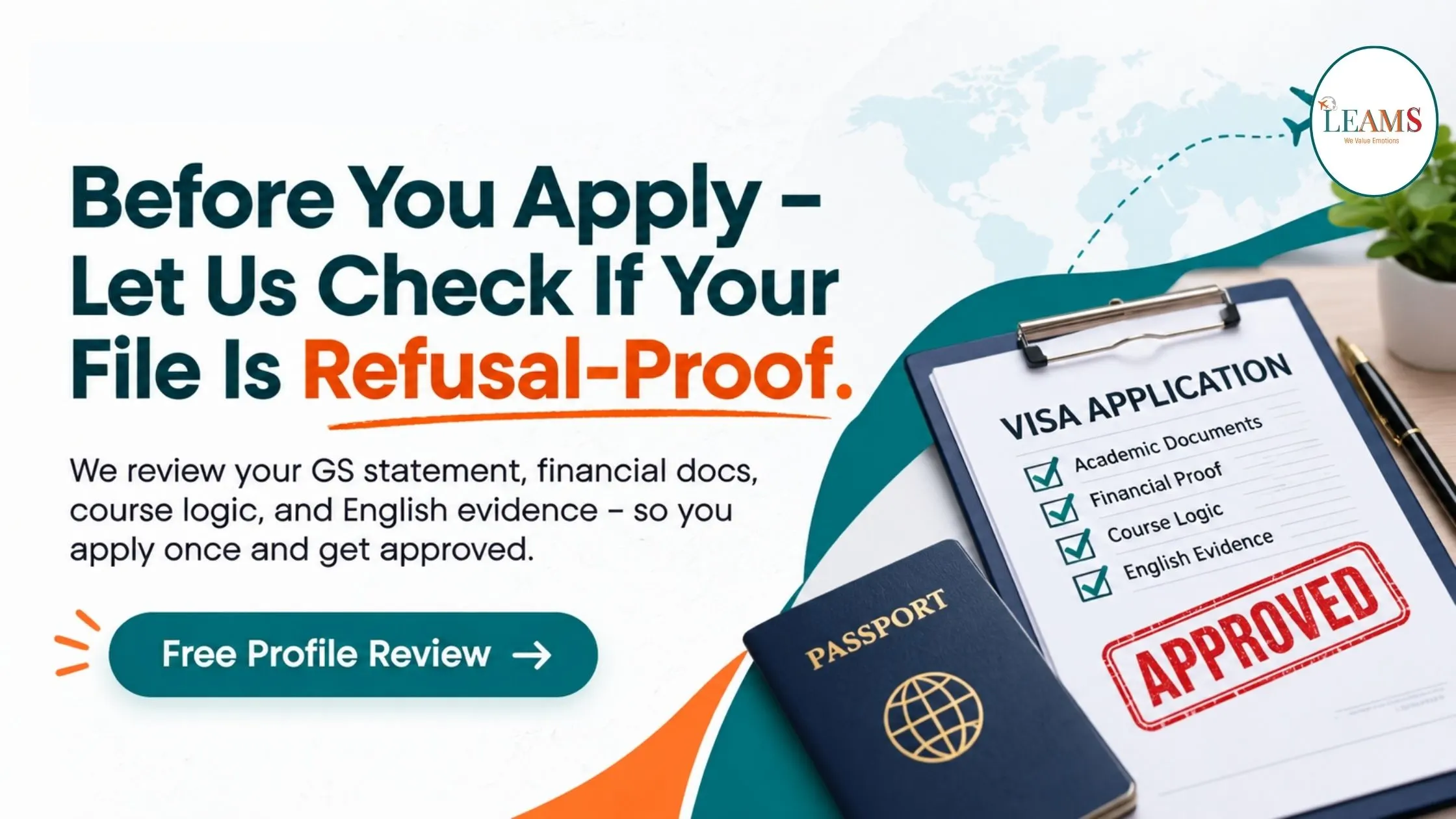
Free Profile Review — we'll check your documents before you lodge
  • WhatsApp us now → [7738352427]
  • Call: 7718882427


Frequently Asked Questions

What is the Australia student visa rejection rate for Indians in 2026?
As of February 2026, 40% of student visa applications from India were refused, the highest rate in over 21 years, according to Australia's Department of Home Affairs. The overall higher education visa approval rate also fell to 67.6%, the lowest in over two decades. By comparison, Chinese applicants faced a rejection rate of only 3% in the same period.
Why was my Australia student visa refused?
Your refusal letter states the grounds for the decision, so read it carefully first. For Indian applicants in 2026, the most common issues are a weak or generic Genuine Student (GS) statement, unclear or untraceable funds, a course that does not match your background, incomplete documents, and English evidence that is borderline or from a non-accepted test. Identify which of these applies to you before deciding your next step.
Can I reapply for an Australia student visa after a refusal?
Yes, a refusal does not permanently bar you from applying again. But you should not lodge the same application a second time. Read the refusal letter, fix the exact issue (for example, rewrite your GS statement, clarify your funds, or choose a course that fits your background) and only then reapply. If the refusal was based on false or misleading information, a longer restriction on applying can apply, so have your refusal letter reviewed by a registered migration agent. Review or appeal rights depend on your situation and on whether you applied from inside or outside Australia, so check your letter for what applies to you.
What is Evidence Level 3 (EL3) and how does it affect Indian students?
Evidence Level 3 is the highest-risk category under Australia's Simplified Student Visa Framework. India was moved to EL3 from 8 January 2026. Indian applicants are expected to provide more detailed financial documentation and stronger proof that study is the primary purpose of the visa. Processing may take longer, and every document may face closer scrutiny. EL3 does not ban Indian students from applying, but a weak or average application is far more likely to be refused than in previous years.
What is a Genuine Student (GS) statement and why does it matter in 2026?
The Genuine Student (GS) statement is a written explanation of why you want to study your chosen course in Australia, how it connects to your background, and what you plan to do after graduation. It replaced the Genuine Temporary Entrant (GTE) requirement in March 2024. For Indian applicants in 2026, a weak or generic GS statement is one of the most common reasons for refusal, so it must be specific, personal and consistent with your documents.
How do I write a Genuine Student statement?
Write it in your own words and cover these points:

1. Your background: what you studied or worked on, and where you live now.
2. Why this course: how it connects to your past study or work and to your career goal.
3. Why Australia and why this provider: real, specific reasons, not lines like "world-class education".
4. How you will fund your studies: who is paying and how the funds match your documents.
5. Your plans after the course: realistic career outcomes, without sounding like a migration plan.
6. Your circumstances: any family ties or previous visa history, explained honestly.

Avoid copied templates and keep every claim consistent with your documents. A registered migration agent can review your statement before you lodge.
How much money do I need to show for an Australian student visa?
As of September 2026, Home Affairs lists the 12-month living-cost amount for a single student applicant as AUD 29,710. This is only one part of what you must show. You also need funds for your first year of tuition fees and your travel costs, plus extra amounts if family members or school-age children come with you. If your course is shorter than 12 months, the living-cost amount is worked out pro rata.

The money must also be genuinely available to you and easy to trace. Sudden large deposits, unexplained sources or an unclear sponsor relationship can lead to refusal even when the balance looks high. Always confirm the current figures on the official Home Affairs student visa page before you apply.
What IELTS score is needed for an Australia student visa in 2026?
The minimum IELTS score for a student visa is 6.0, raised from 5.5 in March 2024. Because India is an EL3 country, a borderline score of exactly 6.0 may face more scrutiny, so aiming for 6.5 or higher reduces the risk. Make sure your test is still valid and is on the current list of accepted English tests, which was updated in August 2025.
Is a Letter of Offer enough to apply for an Australian student visa from inside Australia?
No. From January 2025, students applying from within Australia must provide a current Confirmation of Enrolment (CoE), not just a Letter of Offer.
How long does an Australian student visa take to process?
Processing time depends on your education provider and when you apply. Under Ministerial Direction 115, offshore applications are prioritised based on your provider's allocation threshold. Applying early with a complete, well-prepared file gives you the best chance of a faster decision. Check the Home Affairs website for current processing times, as they change regularly.
Does having family in Australia affect my student visa application?
It can. If a visa officer believes your main reason for going to Australia is to be near family rather than to study, it may raise concerns about your genuine student status. This does not disqualify you, but your GS statement and course reasoning need to be especially clear and convincing. If you plan to bring your spouse or children, see our guide on Australia student visa dependants 2026 for the new family visa rules.
Can I work on a student visa in Australia?
Yes. Student visa holders can work up to 48 hours per fortnight during study periods. But work cannot be the reason you apply. If your application looks focused on jobs or permanent residency instead of study, visa officers may question your genuine intent.
Online calculator icon
Scroll to top
Online calculator icon
Icone-svg