
Australia Budget 2026: Skilled Migration, PR & Graduate Visa Changes — What Migrants Must Know
Australia Budget 2026: What Every Migrant, PR Applicant & International Student Must Know Right Now
Australia's 2026–27 Federal Budget just changed the rules for migrants. Graduate Visa fees have doubled. Onshore applicants now have a clear structural advantage for PR. And the points test is being reformed to favour younger, more qualified, higher-skilled migrants. If you are working toward PR, studying in Australia, or planning your next visa move — this budget directly affects your timeline and your costs.
But what do these changes actually mean for you?
- Will PR become harder?
- Are international students still welcome?
- Which occupations will have better opportunities?
- And why are onshore applicants suddenly getting a bigger advantage?
In this blog, we break down Australia Budget 2026 in simple, practical language, so you can understand the real impact on your migration journey, avoid costly mistakes, and plan your next move with confidence.
What Is the Permanent Migration Program for 2026–27?
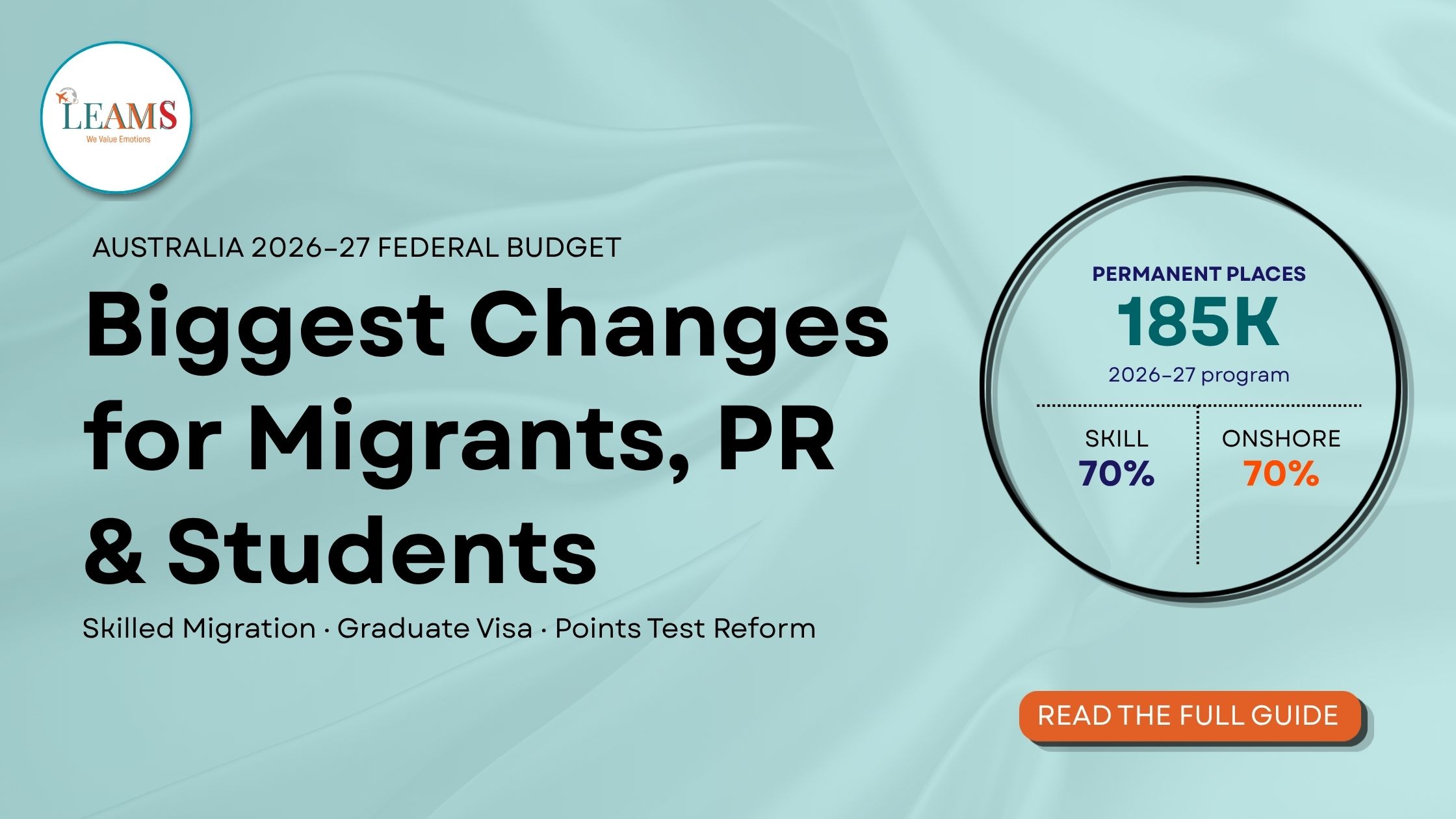
The Australian government has kept the total permanent migration intake at 185,000 places for 2026–27. This is the same overall cap as the previous year, which shows that Australia is not shutting the door on permanent migration. However, it is being much more deliberate about who gets in and how.
Of those 185,000 places:
- 132,240 places are allocated to the Skill stream - that is more than 70 per cent of the total program
- 129,590 places across the Skill and Family streams are reserved for migrants already living inside Australia
- 55,110 places are set aside for offshore applicants
- 300 Special Eligibility places make up the rest
This split between onshore and offshore is one of the most important numbers in the budget. It shows very clearly that people already living and working in Australia have a significant advantage when it comes to securing permanent residency in 2026–27.
Onshore Applicants Are Being Prioritised — Here Is Why That Matters
If you are already in Australia on a temporary visa — whether as a student, a graduate, or on employer sponsorship — this budget is actually good news for you in terms of the permanent program allocation.
The government's decision to direct more than 129,000 places to onshore applicants sends a strong signal. It means that if you are already contributing to the Australian economy and community from within the country, you are more likely to receive an invitation or have your application progressed.
For offshore applicants, this does not mean there is no hope. There are still over 55,000 places available. But competition is stiffer, and the government is clearly focused on rewarding those who are already here and already integrated.
What this means practically:
- If you are on a student visa, staying onshore after graduation could give you a meaningful advantage
- If you are on a Temporary Graduate visa, building a strong skilled profile while onshore is more important than ever
- If you are planning to apply from overseas, you will be competing for a smaller share of places
Skilled Migration Is Still Central — But Selection Is Changing
Australia is not stepping back from skilled migration. In fact, the Skill stream continues to represent more than 70 per cent of the permanent program. But there is a shift happening in how skilled migrants are chosen.
The budget includes a commitment to reform the permanent migration points test. The goal is to make the selection process better at identifying migrants who contribute to long-term productivity and economic growth — not just migrants who meet the minimum criteria.
This is a significant signal. It means that in the coming period, simply meeting the threshold may not be enough. The government wants to bring in skilled migrants who genuinely fill critical gaps and support Australia's economy.
What Is Changing in Skills Assessments?
The budget also includes $4.5 million over four years from 2026–27 to strengthen oversight of the organisations that assess whether your qualifications and work experience meet Australian standards — these are called Assessing Authorities.
Key changes include:
- Greater transparency in how assessments are conducted
- Annual Assessing Authority Performance Reports starting from 2027
- Consultation on requirements for a dedicated skills migration commissioner
For engineers, IT professionals, accountants, nurses, teachers, and many other professionals, your skills assessment is a critical part of the PR process. Stronger oversight of assessing authorities means more rigour - and that your assessment result needs to reflect genuine, verifiable experience.
Temporary Graduate Visa (Subclass 485) Fee Has Doubled — Here Is What That Means for You
This is one of the biggest practical changes in the 2026 Budget for migrants already in Australia.
The government has doubled the visa application charge for the Temporary Graduate Visa (Subclass 485) - a 100 per cent increase - effective from 1 March 2026. The only exception is for eligible applicants from Pacific Island nations and Timor-Leste.
This fee increase is expected to raise approximately $1.2 billion over five years.
Why does this matter? Because the Temporary Graduate Visa is one of the most commonly used transition pathways. After finishing their studies, many international students apply for this visa to stay in Australia, gain work experience, and build a pathway toward PR.
Doubling the application charge does not close this pathway. But it does raise the financial hurdle considerably. If you are planning to apply for a graduate visa, you need to factor this increased cost into your planning now.
Key takeaway: The 485 pathway is still open — but at AUD $4,600 for the main applicant, the cost is now a real planning factor. Do not wait until your course ends to figure out your finances and your next visa step.
International Students: More Scrutiny Is Coming
If you are an international student or planning to study in Australia, the Budget includes specific funding aimed at strengthening the integrity of the student visa system.
The government has allocated $19.8 million over four years from 2026–27 specifically for enhanced scrutiny of both onshore and offshore student visa applications.
This does not mean it has become harder for genuine students to get a visa. What it does mean is that applications will be reviewed more carefully, with a stronger focus on whether each applicant has a genuine intention to study and whether the educational institution and course are genuinely appropriate.
What this means for student visa applicants:
- Your application documents need to be complete, accurate, and genuine
- Your course selection and institution should align with your stated goals
- Any gaps or inconsistencies in your application are more likely to attract scrutiny
- Post-study migration intentions should be clearly separated from your student visa purpose
If you are working with a registered migration agent, make sure they are preparing a thorough and well-documented application from the start.
Migrant Workers: The Budget Supports Your Rights
One often-overlooked part of the 2026 Budget is a direct investment in migrant worker protection. The government has committed $27 million over two years from 2026–27 to continue education and information activities that help migrant workers understand their workplace rights, protections, and compliance obligations under Australian migration law.
This matters because many migrants — especially those on temporary visas — are not fully aware of their rights at work. Unscrupulous employers sometimes take advantage of this. The budget investment in education is a signal that the government takes this seriously.
If you are a migrant worker in Australia, you should know:
- You have the same basic workplace rights as Australian citizens and permanent residents
- Minimum wage, penalty rates, and fair work conditions apply to you
- You can report workplace exploitation without automatically losing your visa
- The Fair Work Ombudsman has specific resources for migrant workers
Net Overseas Migration Is Declining - And That Shapes the Whole Picture
The broader context for all these changes is that Australia's net overseas migration (the number of people arriving minus those leaving) has already dropped by around 45 per cent from its peak in 2022–23. The budget projects that this decline will continue through to 2027–28.
This does not mean Australia is trying to push migrants away. It means the government is trying to manage migration growth more carefully than it did during the post-pandemic boom. The message is one of managed restraint: Australia still wants skilled migrants, but it wants to grow the migrant population at a more sustainable pace.
For migrants, this broader context explains why many of the tighter measures exist. It is not anti-migration — it is about control, quality, and long-term planning.
Summary: What Budget 2026 Means by Migrant Type
| Migrant Group | Key Budget Impact |
| Skilled PR applicants (onshore) | Strong allocation of onshore places — advantage for those already here |
| Skilled PR applicants (offshore) | Fewer places, more competition — strong profile required |
| International students | More integrity checks on applications — document quality is critical |
| Temporary Graduate Visa applicants | Visa application charge doubled from 1 March 2026 |
| Employer-sponsored workers | Skilled stream remains large — pathway still viable |
| Migrant workers (all temporary visas) | Increased education funding for workplace rights awareness |
Conclusion
The 2026–27 Budget is not anti-migration — it is pro-skilled, pro-onshore, and pro-quality. The cap is unchanged at 185,000. The Skill stream is still over 70%. But the bar is higher, the costs are up, and the advantage now clearly sits with migrants who are already in Australia, already contributing, and already building their profile. The right response is not worry — it is faster, smarter preparation. Speak to a registered migration agent now, not after your visa expires.
Ready to take the next step? Book a consultation with an experienced immigration consultant today and get guidance based on the latest Budget 2026 settings.
(FAQs)Australia Budget 2026 :-
Q.1 How many permanent migration places does Australia have in 2026–27?
Q.2 Has the Temporary Graduate Visa fee changed in 2026?
Q.3 Are onshore applicants preferred over offshore applicants in 2026?
Based on the budget's allocation of 129,590 places to onshore applicants (compared with 55,110 offshore places), people already living in Australia do appear to have a structural advantage under the current program settings.
Q.4 Is the migration points test changing in Australia?
Yes. The government has announced plans to reform the permanent migration points test to better identify migrants who contribute to productivity and long-term economic growth. The exact changes are still being consulted on, but the direction is toward more selective and skill-focused scoring.
Q.5 Is net overseas migration still falling in Australia?
Yes. Net overseas migration has already fallen by around 45 per cent from its 2022–23 peak, and the budget forecasts it will continue to decline through 2027–28. This reflects the government's broader goal of managing migration growth at a more sustainable pace.
Q.6 What are the biggest changes in Australia's 2026 Budget for migrants?
The three biggest changes are: (1) the Temporary Graduate Visa fee has doubled to AUD $4,600 from 1 March 2026, (2) onshore migrants are strongly prioritised with 129,590 permanent places versus only 55,110 for offshore applicants, and (3) the permanent migration points test is being reformed to favour younger, more educated, and higher-skilled migrants.
Speak Directly with our Expert:
WhatsApp: +91 77383 52427
Email Us: ladhani@leamss.com
Visit Our Website: www.leamss.com
 Back to Home