
Is Your Course Change About to Cancel Your Australian Visa? 5 Risks No One Tells You
Is Your Course Change About to Cancel Your Australian Visa? 5 Risks No One Tells You (2026)
You picked a different course. The new college accepted you. You think you're sorted.
You're not.
Every week, international students in Australia make course changes that look completely harmless — and unknowingly trigger a visa compliance breach that can cancel their student visa, block their 485 graduate visa, and shut down their entire PR pathway.
In 2026, the Department of Home Affairs is watching course changes more closely than ever. One wrong move — even with good intentions — can follow you through the immigration system for years.
Before you sign that enrolment form, read these 5 risks. This could save your visa.
Why 2026 Is the Worst Year to Make a Careless Course Change
Australia's student visa system has evolved significantly. Today, every visa is granted based on a specific study plan - and any change to that plan is now reviewed by the Department of Home Affairs against one key question:
"Is this student's pathway still genuine?"
Immigration officers look at the full picture: your original AQF qualification level, your education provider, your long-term career intention, and the overall purpose of your stay. Even a small change can raise red flags if it looks casual, convenience-driven, or disconnected from your original goals.
And here's the catch — a CRICOS-registered course alone isn't enough. Your new pathway must still make sense as part of a genuine, coherent study plan. Otherwise, you risk triggering a compliance review that could affect your current visa and every future application.
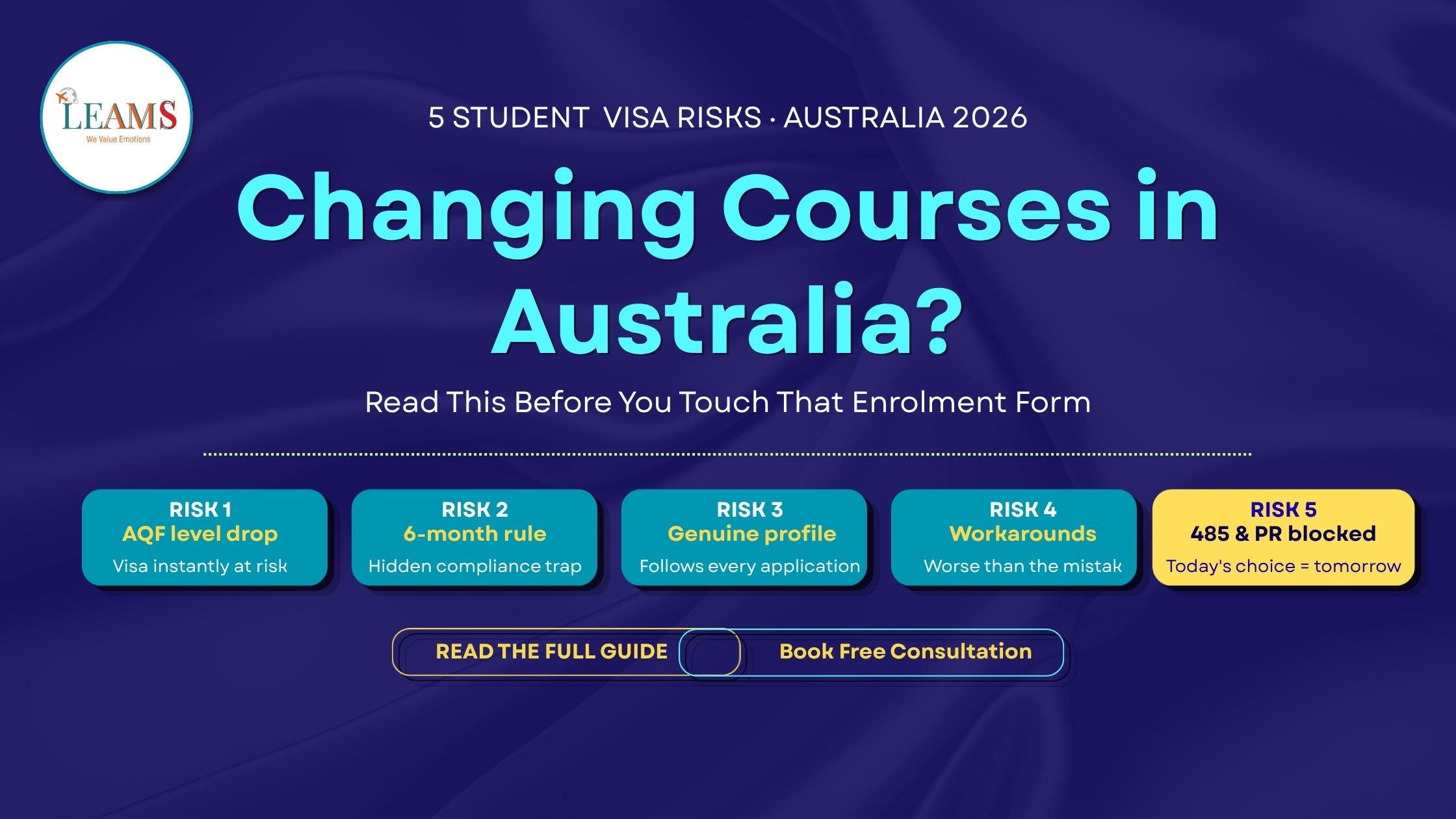
Risk 1: Dropping Your AQF Level — The Mistake That Flags You as Non-Genuine
This is the single most common mistake LEAMSS sees — and the one with the most severe consequences. Student visa holders are generally expected to study at the same or a higher AQF qualification level than the course approved in their original visa grant.
If you drop to a lower level, immigration authorities may conclude that your original study plan was not genuine. The table below shows the highest-risk changes:
| From | To | Risk level |
| Master's degree | Bachelor's degree | Very high |
| Bachelor's degree | Diploma | Very high |
| Diploma | Certificate program | High |
| AQF-registered course | Non-AQF program | Very high |
| Bachelor's degree | Different bachelor's (unrelated field) | Medium |
| Diploma | Bachelor's (same field) | Lower risk |
Important - Even if a new college happily enroll you, the visa you hold may no longer be valid for that lower-level course. Proceeding without professional advice puts your entire stay in Australia at risk.
Risk 2: The 6-Month Rule That Catches Students Off Guard Every Single Year
Did you know there are strict limits on when you can transfer to a new institution after arriving in Australia? In most cases, students cannot transfer to another education provider within the first 6 months of commencing their principal course — unless specific conditions apply, such as the provider closing or a significant provider failure.
Common mistakes that trigger a compliance breach:
- Assuming that being accepted by a new college means you can simply leave your current one
- Stopping classes before the formal transfer process is complete
- Not obtaining a proper release letter from your current provider
- Enrolling concurrently in multiple institutions as a workaround
Each of these can trigger a compliance breach with the Department of Home Affairs — even when your intentions are entirely legitimate.
Risk 3: One Course Change Can Quietly Destroy Your "Genuine Student" Status
Australia's student visa system is increasingly focused on the concept of genuine temporary entrants — students who have a real intention to study and are following a logical academic pathway.
If your course change raises questions — for instance, if it has no clear connection to your previous education, is significantly easier or cheaper with no clear rationale, or doesn't support any identifiable career goal — it can damage your profile for future applications including:
- Visa extension applications and student visa renewals
- The Temporary Graduate visa (subclass 485)
- Employer-sponsored permanent residency pathways
- Skilled migration applications (subclass 189, 190, 491)
A single poorly documented course change can follow you through the immigration system for years.
Risk 4: Trying to Be Clever? The Department of Home Affairs Is Already Watching
Some students try to bypass transfer restrictions by enrolling in multiple courses concurrently or using informal pathways to switch providers. In 2026, compliance monitoring by the Department of Home Affairs has become significantly more sophisticated.
Attempting to circumvent official transfer rules is treated as more serious than a straightforward, if premature, transfer. It establishes a pattern of non-compliance — which is very difficult to reverse and can affect all future visa applications.
Risk 5: How One Course Switch Can Wipe Out Your 485 Visa and PR Plans
For many international students, studying in Australia is Step 1 in a longer migration plan. That's perfectly normal — and perfectly legal. But your course choices today have consequences tomorrow.
Post-study work rights and eligibility for the Temporary Graduate visa (subclass 485) typically depend on:
- Completing a CRICOS-registered eligible qualification
- Meeting minimum study duration requirements (often 2 years for bachelor's level and above)
- Demonstrating a clear, uninterrupted academic pathway
- Graduating from a regional institution or in a priority occupation (for extended 485 stream)
If a course change creates a study gap, results in a lower qualification outcome, or disrupts your academic timeline, it can significantly reduce — or eliminate — your 485 visa options.
The Only Situations Where a Course Change Won't Hurt Your Visa
Not all course changes are problematic. LEAMSS generally considers the following situations lower-risk — provided they are handled correctly and documented thoroughly:
- Switching to a higher AQF qualification level (e.g., diploma to bachelor's)
- Changing courses within the same institution after the initial restricted period
- Moving to a closely related field with a documented career rationale
- Transferring to a new provider after the 6-month restriction period with a formal release letter
- Maintaining continuous enrolment throughout the entire transition period
The key principle in every case: alignment. Your new course must still support a genuine and coherent academic and career pathway.
Do These 5 Things Before You Change Anything — Or Risk Losing Your Visa
| Speak to a Migration agent | not just the admissions office of the new college. Your education provider manages your enrolment; your visa compliance is your responsibility. |
| Check that your new course aligns with your current visa conditions | Specifically the AQF level and study duration requirements. |
| Confirm you are past the 6-month provider restriction period | Or that you qualify for a specific exemption. |
| Obtain a formal release letter | From your current institution before transferring to any new provider. |
| Document your academic and career rationale clearly | Your reasoning matters to immigration authorities and must be on record. |
Don't Risk Your Visa. Get Expert Advice First.
Changing a course in Australia can be done safely — but only if you understand the visa implications before you act.
LEAMSS migration agents specialise in student visa matters. We'll review your full situation — your current visa, your study history, and your goals — and give you a clear, honest assessment of your options. Book a Free Consultation with a LEAMSS Migration Agent.
(FAQs) Change course on student visa australia :-
Q.1 Can I change my course on an Australian student visa?
Q.2 What is the 6-month rule for student visa holders in Australia?
Q.3 Do I need a release letter to change education providers?
Yes. If you are transferring within the first 6 months of your principal course, a release letter from your current provider is required. After 6 months, a release is still standard good practice and protects you from compliance issues.
Q.4 Should I tell Home Affairs before changing my study situation?
Yes, absolutely. In 2026, the Department of Home Affairs operates under a "Notification First" principle. Failing to update your situation can lead to a breach of Visa Condition 8202
Q.5 Can changing courses affect my 485 visa plans?
Yes, significantly. Your eligibility for the Temporary Graduate (subclass 485) visa depends on the Australian Study Requirement (ASR). A course change can inadvertently reset your progress or disqualify you entirely.
 Back to Home