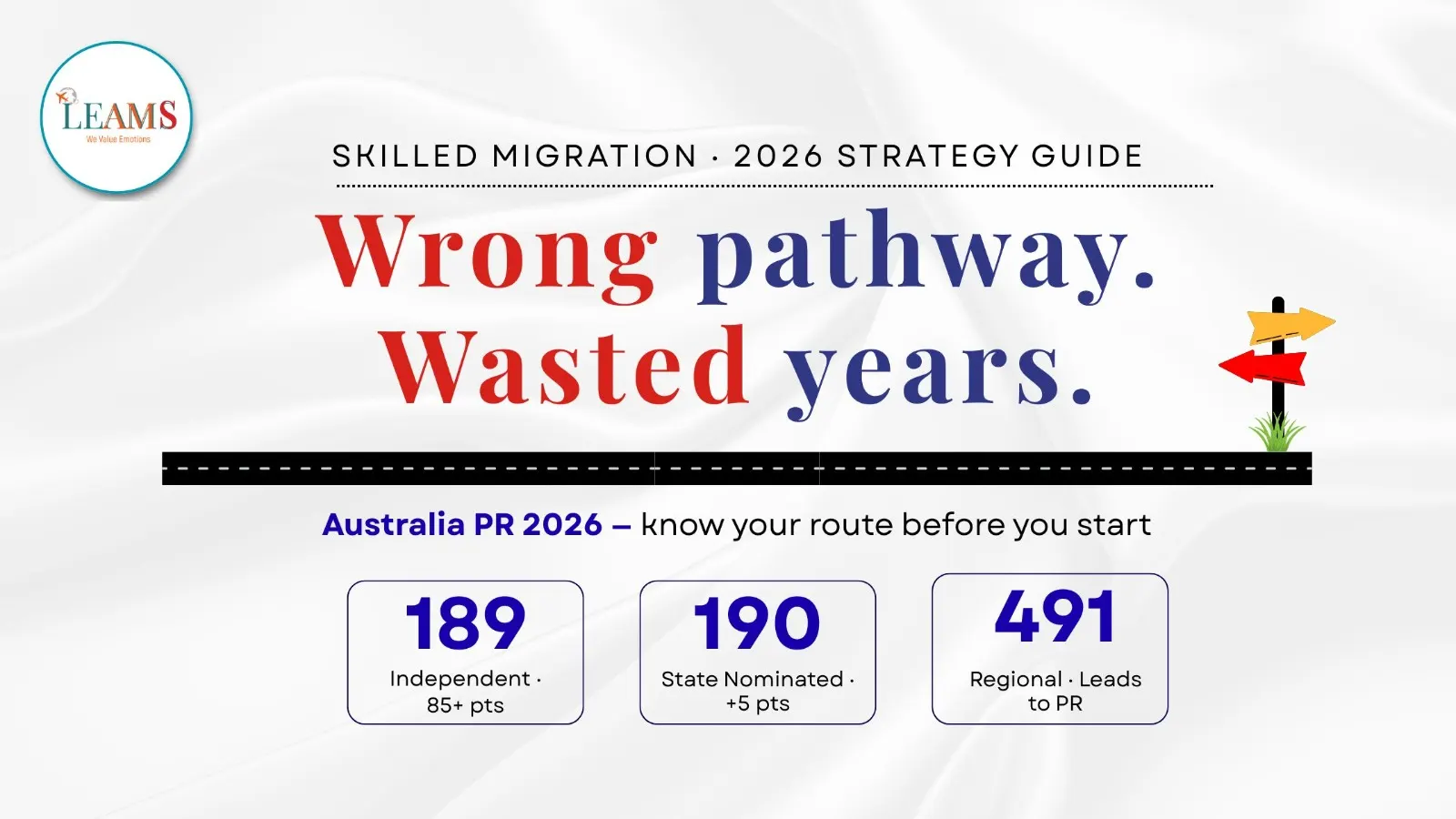

Australia PR 2026: Picking the Wrong Pathway Is Costing Skilled Migrants Years — Here Is How to Choose Right
Australia PR 2026: Most Skilled Migrants Pick the Wrong Pathway First — Here Is How to Get It Right
Every year, thousands of skilled professionals apply for Australian PR with the wrong strategy. Not because their profile is weak — but because they chose the wrong pathway for their specific situation and wasted months, sometimes years, waiting for invitations that were never going to come.
In 2026, Australia's skilled migration system is more data-driven and competitive than ever. The difference between an applicant who gets invited in 90 days and one who waits 3 years is rarely their points score. It is their pathway choice.
This guide tells you exactly how to choose the right one — based on your occupation, your points, your employer, your state, and your partner's profile. By the end, you will know which route fits your specific situation and what to do next.
Why "Which Is the Best PR Visa?" Is the Wrong Question — and What to Ask Instead
Most people searching for Australia PR begin with questions like "Should I go for subclass 189 or 190?" or "Is employer sponsorship easier?" These are reasonable questions — but they skip the most important step: understanding your own profile first.
Australia's skilled migration system is designed to match migrants to pathways based on what Australia needs, not what migrants prefer. That means the "best" visa is always the one that fits your specific situation. Two people with similar qualifications can end up on completely different PR routes — and both can succeed if they choose strategically.
Key takeaway :- Stop asking which visa is best. Start asking which pathway fits your profile best. The difference in approach leads to a completely different — and far more successful — outcome
Before You Look at Any Visa Subclass, Check These 5 Things About Your Own Profile
Before exploring specific visa subclasses, you need to evaluate five core factors. Together, these will point you toward the pathway most likely to succeed.
Your Occupation
Everything begins here. Is your occupation listed on one of Australia's skilled migration lists? If yes, how in-demand is it? Some occupations open multiple PR pathways. Others are restricted to certain states or regional areas.
Your Points Score
The points test assesses age, English proficiency, work experience, qualifications, and other factors. Knowing your score helps you understand which visa subclasses you're competitive for — not just eligible for.
Employer Support
Do you have a current Australian employer willing to sponsor you? If yes, direct employer-sponsored PR pathways become available — and they can bypass the invitation queue entirely.
State & Regional Flexibility
Are you open to living outside major cities like Sydney or Melbourne? Regional and state-based pathways often have lower competition and higher approval rates for many occupations.
Your Partner's Profile
A skilled or English-proficient partner can add valuable points to your application. And if your partner is an Australian citizen or permanent resident, a family-based pathway may actually be your fastest route to PR.
Australia PR Pathways Explained: Which One Fits You?
Now let's look at the major PR pathways available in 2026 and who each one is best suited for.
Subclass 189 — Skilled Independent
Direct PR with no state or employer requirement. Highly competitive. Best for applicants with high points and a strongly demanded occupation.
Subclass 190 — State Nominated
PR granted with state government nomination. Adds 5 bonus points. Ideal for applicants with moderate points whose occupation is in demand in a specific state.
Subclass 491 — Skilled Regional
Temporary visa for regional areas. Leads to PR via Subclass 191 after meeting income and residence requirements. Good for those with lower points or flexible location preferences.
Subclass 186 — Employer Nomination
Direct PR through a sponsoring employer. Less reliance on points. Requires a genuine job offer with minimum salary and skills assessment compliance.
Partner / Family Visa
If your partner is an Australian citizen or PR holder, this can be the fastest and most direct route. No points test required.
Business Innovation & Investment
For entrepreneurs, investors, or business owners. Requires significant business track record or investment capital. State nomination is often required.
65 Points Gets You Into the Pool. Here Is What Actually Gets You an Invitation.
One of the most common misconceptions about Australia's PR system is that meeting the minimum points threshold means you will receive an invitation. In reality, 65 points is just the entry ticket — it gets you into the pool, but it does not guarantee selection.
| Points Range | Realistic Expectation | Recommended Strategy |
| 65–74 | Unlikely for 189. Possible for state routes | Focus on 190 or 491, or employer sponsorship |
| 75–84 | Competitive for 190 in many states | State nomination or regional pathways |
| 85–94 | Good chances for 189 in several occupations | 189 or 190 depending on occupation demand |
| 95+ | Strong position across most occupations | 189 or employer-sponsored PR |
Choosing a State for PR? Stop Thinking Lifestyle — Start Thinking Invitation Rates
Choosing a state to live in is a personal decision. But for PR purposes, state selection must be a strategic one.
Different states have different occupation demand lists, different invitation cut-offs, and different regional sub-streams. Applicants who limit themselves to major cities like Sydney and Melbourne often face significantly higher competition compared to those open to states like South Australia, Tasmania, or regional Queensland.- Check the current state nomination occupation lists for each state before applying
- Some states offer dedicated streams for international students, graduates, or specific industry sectors
- Regional areas under the 491 visa can offer dramatically better invitation rates
- Consider that after PR is granted, you are free to move anywhere in Australia
Pro tip :- Many applicants initially settle in a regional area to secure their PR invitation and then relocate to a major city once their permanent residency is confirmed. This is a fully legal and widely used strategy.
- Check the current state nomination occupation lists for each state before applying
- Some states offer dedicated streams for international students, graduates, or specific industry sectors
- Regional areas under the 491 visa can offer dramatically better invitation rates
- Consider that after PR is granted, you are free to move anywhere in Australia
Already Working in Australia? Your Employer Could Be Your Fastest Route to PR
If you are currently working in Australia on a temporary skilled visa, your employer may be willing to sponsor you for permanent residency through Subclass 186. This pathway does not depend on the SkillSelect invitation rounds — instead, it depends on your employer's compliance with sponsorship obligations and your own eligibility under the relevant stream.The Temporary Residence Transition stream requires you to have worked with the same employer for at least two years in the nominating role. The Direct Entry stream is for applicants who haven't previously worked for their Australian employer but have a genuine job offer and strong qualifications.Employer-sponsored PR can sometimes be the most reliable route — especially for applicants in occupations with moderate invitation rates in the points system.
Your Partner Could Add 10 Points to Your Application — Are You Using That?
Many applicants treat their partner purely as a dependent on their application. But in Australia's skilled migration system, a partner can be a genuine asset.- A skilled partner (with a relevant qualification and skills assessment) adds 10 points to your application
- An English-proficient partner adds 5 points even without a skills assessment
- In some cases, it may be more strategic for the partner to be the primary applicant rather than the dependent
- If your partner is an Australian citizen or permanent resident, consider the partner visa route — it bypasses the points test entirely
- A skilled partner (with a relevant qualification and skills assessment) adds 10 points to your application
- An English-proficient partner adds 5 points even without a skills assessment
- In some cases, it may be more strategic for the partner to be the primary applicant rather than the dependent
- If your partner is an Australian citizen or permanent resident, consider the partner visa route — it bypasses the points test entirely
Conclusion
Australia PR in 2026 is not just achievable — for the right profile on the right pathway, it is very much within reach this year.The applicants who succeed are not always the ones with the highest points. They are the ones who understood their occupation demand, matched their score to the right subclass, made a smart state or regional choice, and moved before the invitation rounds closed on their opportunity.The ones who wait — usually wait because they chose the wrong route first.[Book a free profile assessment with LEAMSS ]and find out exactly which Australia PR pathway fits your occupation, points, and situation in 2026. One honest conversation now can save you years.
(FAQs) australia pr pathways 2026 :-
Q.1 What is the best PR pathway for Australia in 2026?
There is no single best option. The right pathway depends on your occupation, points score, employer support, state preferences, and partner profile. A personalized assessment is the most reliable way to identify your strongest route.
Q.2 Is 65 points enough to get an invitation for Australian PR?
65 points is the minimum eligibility threshold, but it is not enough to guarantee an invitation — especially for Subclass 189. Most successful applicants have significantly higher scores or pursue state-based or employer-sponsored pathways.
Q.3 Is Subclass 491 a permanent residency visa?
No, Subclass 491 is a temporary skilled regional visa. However, it creates a clear pathway to permanent residency through Subclass 191 after you meet the required income and residence conditions in a regional area.
No, Subclass 491 is a temporary skilled regional visa. However, it creates a clear pathway to permanent residency through Subclass 191 after you meet the required income and residence conditions in a regional area.
Q.4 Can my partner apply separately for Australian PR?
Yes. If your partner has a stronger occupation or higher points score, it may be more strategic for them to be the primary applicant. Both of you can be included in the application regardless of who is listed as the main applicant.
Yes. If your partner has a stronger occupation or higher points score, it may be more strategic for them to be the primary applicant. Both of you can be included in the application regardless of who is listed as the main applicant.
Q.5 Do I need a skills assessment for every Australia PR pathway?
For most skilled migration pathways, yes — a positive skills assessment from the relevant assessing authority is mandatory. Employer-sponsored pathways also generally require a skills assessment, though the specific requirements vary by occupation.
For most skilled migration pathways, yes — a positive skills assessment from the relevant assessing authority is mandatory. Employer-sponsored pathways also generally require a skills assessment, though the specific requirements vary by occupation.
 Back to Home