
6 Visa Rules Every International Student in Australia Must Know in 2026
Studying in Australia in 2026? Here Are the 6 Things That Catch Students Off Guard — and How to Stay Safe
You land in Sydney. You find accommodation, get a SIM card, meet your flatmates. You feel like you've done everything right.Then, six weeks in, you get a call from your university's compliance office. You've been working 52 hours a fortnight. You didn't know that a "fortnight" is a fixed government window — not your employer's pay week. That is a visa breach. This happens every single year to students who were never told the specifics. Not because they were careless — but because nobody explained the rules clearly before they got on the plane. This guide fixes that. Below are the 6 things that actually catch international students off guard in Australia in 2026 — and exactly what to do about each one.
1. Your Student Visa Is a Legal Contract — and Most Students Don't Read the Fine Print
The Subclass 500 Student Visa is the visa held by almost all international students in Australia. It is not simply a stamp that allows you to enter — it is a legal agreement that comes with ongoing obligations from the day you land to the day you leave.
What you are required to maintain
- Continuous enrolment in your registered course
- Satisfactory academic progress and attendance
- Updated personal details with the Department of Home Affairs (DoHA) — including your address
- Compliance with all visa conditions at all times
2. You Can Work — But "48 Hours" Is Not What You Think It Means
Current work hour limits (2026)
- Up to 48 hours per fortnight while your course is in session
- Unlimited hours during official scheduled course breaks
What "fortnight" actually means
Your rights at work
- The National Minimum Wage — currently AUD 24.95/hour (as of July 2025), with a likely increase in July 2026
- Penalty rates for weekend, late-night, and public holiday shifts
- Protection from unfair dismissal, including for asking about your pay
3. The Cost of Living Numbers You See Online Are Real — But They Hide One Dangerous Gap
What the government requires
Accommodation costs across major cities
| City | Weekly rent (shared) | Relative cost |
| Sydney | AUD 220–350 | High |
| Melbourne | AUD 200–320 | Moderate–high |
| Brisbane | AUD 180–270 | Moderate |
| Adelaide | AUD 160–250 | Lower cost |
| Regional areas | AUD 120–200 | Best value |
4. Australian Universities Don't Reward Memorisation — and That Will Surprise You
What lecturers are actually looking for
Academic support services are for everyone
Academic integrity — take it seriously
5. Your 485 Visa Eligibility Is Being Decided Right Now — From Your First Week of Class
What has changed in 2026
Why your study location and course load matter now
6. These First-Week Tasks Feel Boring — But Missing Even One Will Cost You Later
The administrative tasks that feel bureaucratic in your first week are actually among the most important steps you will take. Missing any of them creates problems that are far harder to resolve later.
Bank account , SIM card , Tax File Number , OSHC confirmation , Transport app , Address registration
Open an Australian bank account
Most major banks — including Commonwealth Bank, NAB, and ANZ — allow you to open an account before you arrive in Australia. Do this early. Without a local bank account, you cannot receive wages, pay rent, or access most digital payment platforms.Get a local SIM card
An Australian phone number is essential within days of arrival. It is required for employment applications, two-factor authentication on banking apps, healthcare registration, and transport apps.Apply for a Tax File Number (TFN)
Your TFN is issued by the Australian Tax Office and is legally required before you begin any paid work. Employers who pay you without a TFN on file are required to withhold a higher rate of tax. Apply online through the ATO website as soon as you arrive.Confirm your Overseas Student Health Cover (OSHC)
OSHC is a mandatory requirement of your student visa — not optional. It covers basic medical consultations and hospital treatment throughout your stay. Confirm that your policy is active before you depart your home country, and carry your membership details with you at all times.Learn your local transport system
Each Australian city operates its own public transport card system. The Opal card covers Sydney's trains, buses, and ferries. The myki card is used in Melbourne. Download the relevant app and load your card within your first 48 hours — you will need it daily.Conclusion
(FAQs) International students australia 2026 :-
Q.1 How many hours can international students work in Australia in 2026?
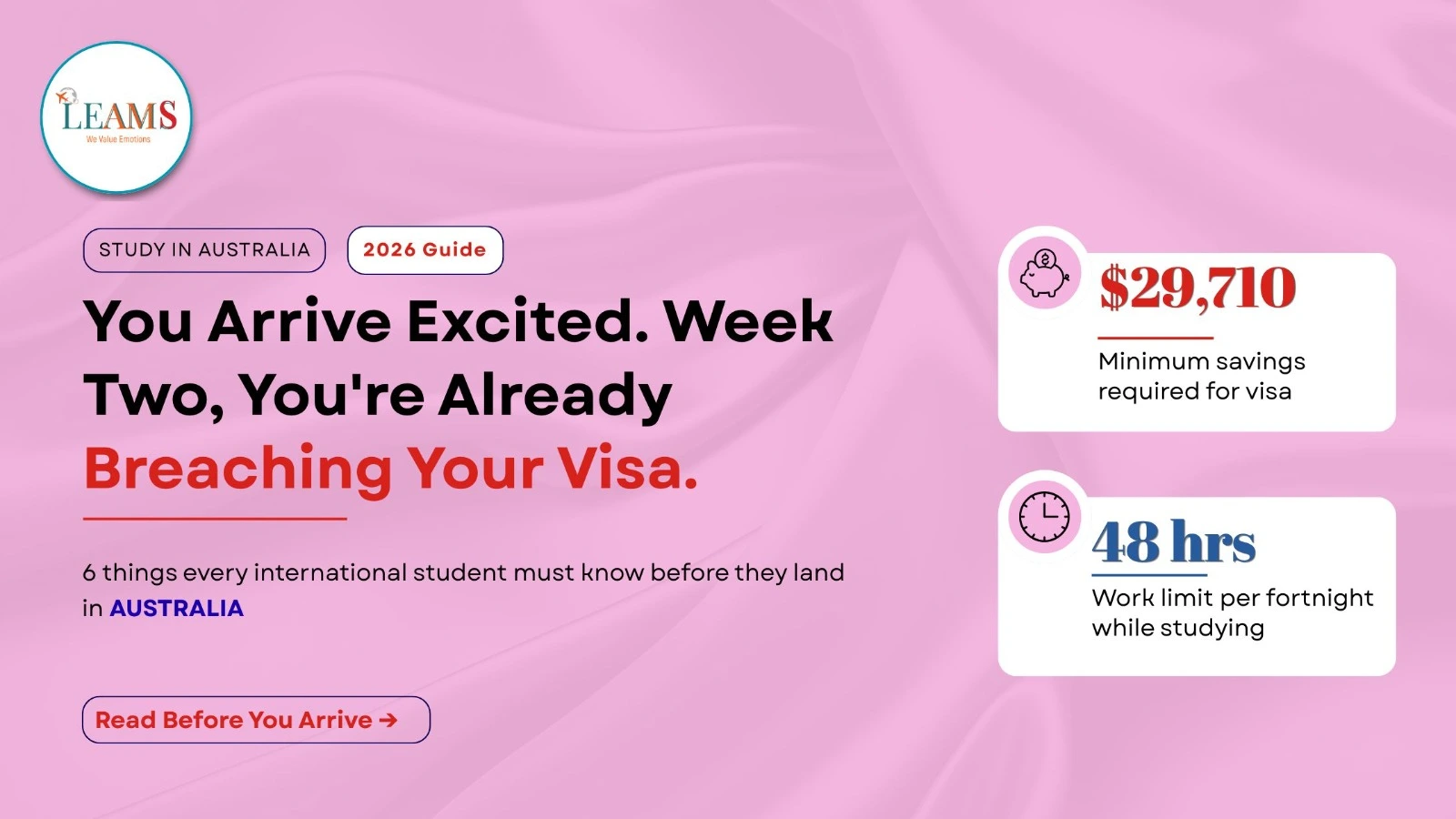
International students on a Subclass 500 visa can work up to 48 hours per fortnight while their course is in session, and unlimited hours during official scheduled course breaks. A proposed increase to 60 hours per fortnight is expected from 1 July 2026, but you should not increase your hours until this change is officially confirmed for your visa category.
Q.2 How much money do I need to show to get an Australian student visa in 2026?
For 2026, the Department of Home Affairs requires you to demonstrate access to at least AUD 29,710 in savings for a single student. This is a minimum compliance figure. In reality, given the cost of accommodation, food, transport, and course materials, having a three-month expense buffer beyond this amount is strongly advisable.
Q.3 Is OSHC mandatory for international students in Australia?
Yes. Overseas Student Health Cover (OSHC) is a mandatory condition of the Subclass 500 student visa. It must be maintained for the full duration of your stay in Australia. It covers basic doctor visits, some hospital treatment, and limited ambulance services. Your institution may arrange OSHC on your behalf, or you may need to purchase it independently — confirm this before you arrive.
Yes. Overseas Student Health Cover (OSHC) is a mandatory condition of the Subclass 500 student visa. It must be maintained for the full duration of your stay in Australia. It covers basic doctor visits, some hospital treatment, and limited ambulance services. Your institution may arrange OSHC on your behalf, or you may need to purchase it independently — confirm this before you arrive.
Q.4 What should I do if my employer is not paying me correctly in Australia?
You are protected by the Fair Work Act regardless of your visa status. First, use the Fair Work Ombudsman's free P.A.C.T. tool to calculate what you should be earning. If there is a discrepancy, contact the Fair Work Ombudsman directly to report underpayment. Wage theft is taken seriously in Australia, and the government provides anonymous reporting options so you do not need to fear retaliation.
You are protected by the Fair Work Act regardless of your visa status. First, use the Fair Work Ombudsman's free P.A.C.T. tool to calculate what you should be earning. If there is a discrepancy, contact the Fair Work Ombudsman directly to report underpayment. Wage theft is taken seriously in Australia, and the government provides anonymous reporting options so you do not need to fear retaliation.
 Back to Home