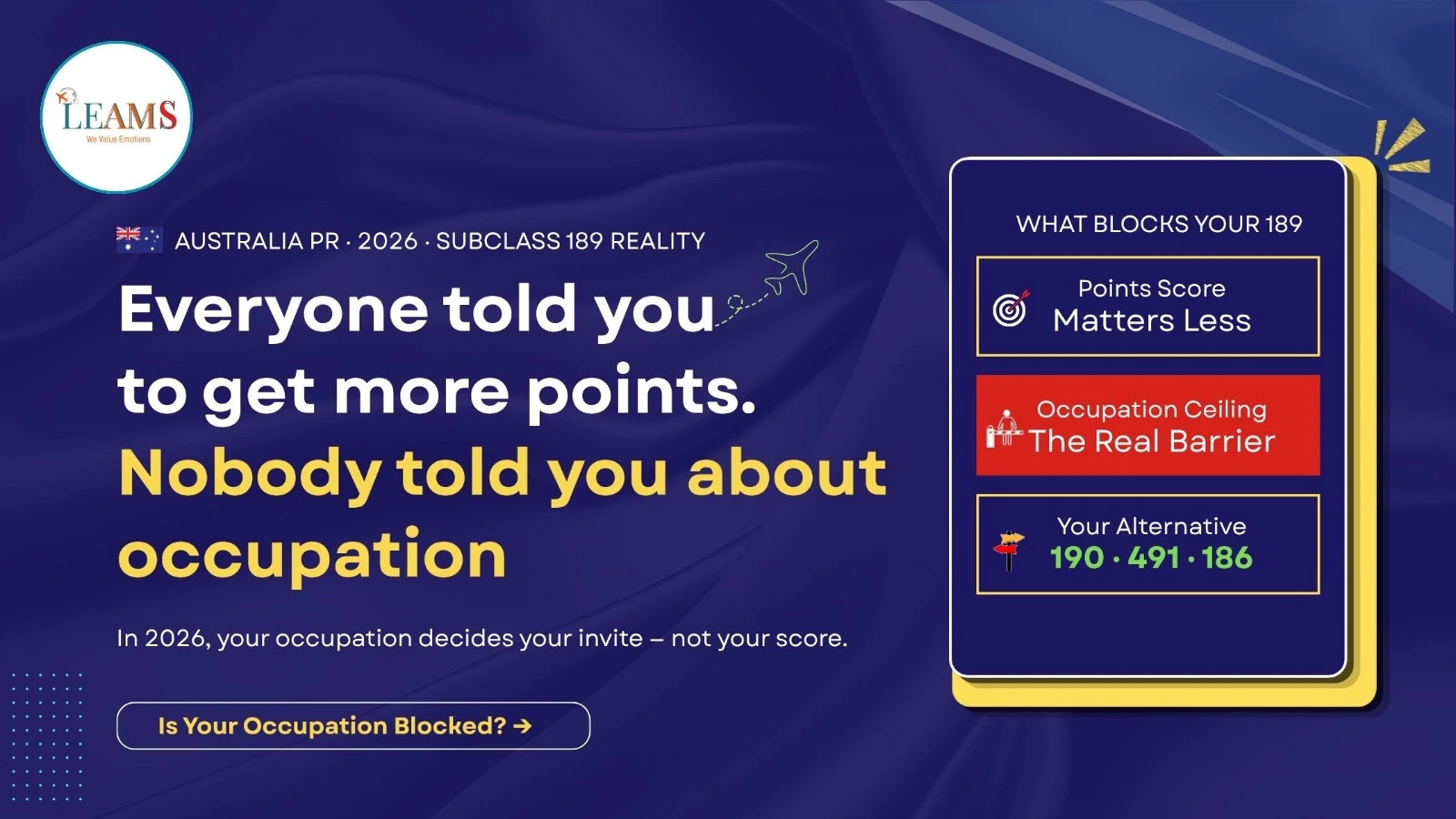
Not Getting a Subclass 189 Invitation in 2026? Here Is Why Your Occupation - Not Your Points - Is the Problem
If you haven't received a Subclass 189 invitation despite a strong points score, the most likely cause is an occupation ceiling, not your profile. Home Affairs caps invitations per occupation group, and once that cap is reached for the year, extra points stop helping. Chefs, motor mechanics, accountants, external auditors, IT professionals, civil engineers, and mechanical engineers are currently at highest risk. The 2025–26 program allocates only 16,900 Subclass 189 places, versus 44,000 employer-sponsored and 33,000 state-nominated places - meaning Subclass 190, Subclass 491, and employer sponsorship are often faster, not weaker, alternatives.
What Is Subclass 189 and Why Is It So Competitive?
The Skilled Independent visa (Subclass 189) is one of the most sought-after permanent residency pathways in Australia because it offers three things no other skilled visa does: immediate permanent residency, no state or territory tie, and no employer sponsorship requirement.
That combination drives enormous demand against limited supply. The 2025–26 Migration Program set the Skilled Independent planning level at just 16,900 places, with 10,000 invitations issued in the November 2025 round alone, according to Home Affairs invitation round data.
So yes, another round is mathematically possible before June 30. Whether your occupation is included in it is a separate question entirely.
Why More Points Won't Get You a Subclass 189 Invitation If Your Occupation Hit the Ceiling
7 Occupations at Highest Risk of No Subclass 189 Invitation in 2025–26
| Occupation | Why It Is Concerning | What You Should Explore Instead |
| Chef | No realistic 189 window remaining | WA nomination, Subclass 190/491, employer sponsorship |
| Motor Vehicle / Motor Mechanic | Appears effectively closed for 189 | State nomination and employer-sponsored routes |
| Accountants (various) | Ceiling pressure from high competition | Subclass 190, 491, state-targeted strategies |
| External Auditor | Mirrors accounting occupation challenges | State and employer pathways |
| IT Professionals | Crowded field, weak 189 momentum | Compare 190, 491, Skills in Demand visa |
| Civil Engineer | Unexpectedly low 189 movement | Employer sponsorship or state nomination |
| Mechanical Engineer | Similar weakness in 189 queue | State nomination, sponsorship routes |
Blocked From Subclass 189 Invitations? You Still Have 3 Stronger Pathways to Australian PR
| Visa Category | Planning Level |
| Employer Sponsored | 44,000 places |
| State/Territory Nominated | 33,000 places |
| Skilled Regional | 33,000 places |
| Skilled Independent (189) | 16,900 places |
State Nomination Is Where 189-Blocked Occupations Are Getting Invited Right Now
Western Australia Is a Strong Example
| Occupation | WA Invitation Evidence |
| Chef (351311) | Invited in WA March 2026 round at 85 points |
| Civil Engineer (233211) | Invited in WA March 2026 round at 80 points |
| Accountant (General) | Appears in WA invitation data |
| ICT Business Analyst | Appears in WA invitation data |
| Developer Programmer / Software Engineer | Appears in WA invitation data |
| Motor Mechanic | Appears in WA invitation data |
| Mechanical Enginee | Appears in WA invitation data |
44,000 Employer Sponsored Places vs 16,900 for Subclass 189 - This Is Not a Backup Plan
Yes, Another Subclass 189 Round May Come - But It Will Probably Skip Your Occupation
Your 4-Step Plan If Your Occupation Is Blocked From Subclass 189 Invitations
The Hard Truth About Subclass 189 Invitations in 2026 — and Why Waiting Costs You the Most
Get Honest Guidance from LEAMSS Today.
(FAQs) Subclass 189 invitation 2026 :-
Q.1 What is an occupation ceiling in the Subclass 189 visa system?
An occupation ceiling is an upper limit set by the Department of Home Affairs on how many applicants from a particular occupation group can receive invitations in a given program year. Once that ceiling is effectively reached, even strong points scores will not result in a 189 invitation for that occupation - regardless of how many further rounds occur.
Q.2 Which occupations are most at risk of not receiving a 189 invitation this year?
The occupations currently flagged as highest risk are chefs, motor mechanics, accountants, external auditors, IT professionals, civil engineers, and mechanical engineers. These are based on current trend analysis, not a confirmed Home Affairs announcement.
Q.3 Does getting more points help if an occupation ceiling is already exhausted?
Not for the 189 pathway. Once the ceiling for your occupation is effectively used up for the financial year, accumulating extra points does not reopen the door. Higher points help in SkillSelect only when your occupation still has remaining capacity.
Q.4 How do I know which states are currently inviting my occupation?
Each state and territory publishes its own occupation lists and invitation data, which are updated regularly. Checking the latest lists from states like Western Australia, South Australia, and Tasmania - or using a tool like OccuSearch - can show you where your occupation is currently moving.
Q.5 Can part-time jobs support living expenses abroad?
Part-time jobs can help cover basic living costs like groceries, transport, or shared rent - but they rarely cover full expenses. With visa hour limits and rising costs in 2026, you’ll still need savings for tuition and financial stability.